Best Textured Foam Roller for Teens: TriggerPoint Wins

A verdict-first guide to the best textured foam roller for teens, built from published specs. TriggerPoint Grid 1.0 leads on a 13 in multi-density body, with named runners-up for beginners, families and heavy use.

By Alicia RoseUpdated 16 min read
On this page
- Best textured foam roller for teens at a glance
- How I screened these six rollers
- What actually decides a teen's roller
- 1. TriggerPoint Grid 1.0 Foam Roller — Best overall
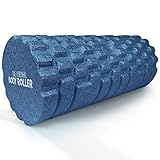
- 2. The Original Body Roller — Best for beginners
- 3. RumbleRoller Basic Bumpy Foam Roller — Best for heavy use
- 4. 321 STRONG Patented 3-Zone Massage Roller — Best for families
- 5. Amazon Basics High-Density Foam Roller — Best budget pick
- 6. JOYVANTAGE Foam Roller — Best premium
- Is a textured roller safe for a 14-year-old?
- How long does a foam roller last with daily use?
- Head-to-head: TriggerPoint vs RumbleRoller
- What the listings do not tell you
- The verdict
- FAQ
The best textured foam roller for teens is the TriggerPoint Grid 1.0, a 13 in multi-density roller at 1.1 lb whose ridged surface targets the tight hips, quads and upper back that pile up during a growth spurt and a full sports schedule. The runner-up is the Original Body Roller at 0.5 lb, a lighter and cheaper pick for a first-time user who still wants texture. Here is the price-band map for this set: entry rollers give you a usable surface and little else, mid picks add real bump texture and higher weight limits, and premium picks add either a proven multi-density pattern or extra length.
Best textured foam roller for teens at a glance
| Pick | Length | Texture claim | Price |
|---|---|---|---|
Best overall TriggerPoint Grid 1.0 |
13 in | Multi-density ridges and nodules | Check Price |
Best for beginners The Original Body Roller |
12.5 in | 3D triple-zone (finger, thumb, palm) | Check Price |
Best for heavy use RumbleRoller Basic Bumpy |
13 in | Bumpy grid, 300 lb load claim | Check Price |
Best for families 321 STRONG 3-Zone |
12.5 in | Patented 3-zone projections | Check Price |
Best budget pick Amazon Basics High-Density |
12 in | Smooth (no textured surface) | Check Price |
Best premium JOYVANTAGE Foam Roller |
15 in body, 4.7 in diameter | Multi-density nodules and ridges | Check Price |




A quick note on the keyword itself. Amazon's search returned general foam rollers rather than a teen-specific product line, and none of the six listings advertises a teen-only design. Every pick below is a general adult roller, and I have chosen for the size, weight and firmness that suit a teenage user rather than pretending a "for teens" label exists.
How I screened these six rollers
I started with the six textured or firm rollers in this data set, all sitting in Amazon's Foam Rollers category. Two are entry-priced, two are mid, two are premium. Length runs from 12 in to a 15 in body, weight from 4.32 oz to 2 lb. That spread is the point: a 12-year-old on a 12 in roller has a different rolling job than a 17-year-old lacrosse defender working a whole posterior chain.
Variant 1 methodology, so here are the three reasons a pick got cut from the top spot rather than the shortlist.
- No published texture. The Amazon Basics roller is smooth polypropylene. It is a great starter surface, but it is not what the keyword asks for.
- Weak durability signal. A hollow or lightly-built roller under a 130 lb teen doing hip work is fine; under a 170 lb teen doing thoracic extensions, it flattens. Rollers without a stated load capacity dropped down the ranking.
- Wrong length for the job. A 15 in body is generous for back rolling but awkward for calves in a small bedroom. That balance decided several close calls.
What survived: rollers with a real textured surface, a stated construction that will not collapse under a growing athlete, and a size that fits a school gym bag.
What actually decides a teen's roller
Most roller guides compare bump height. That is not what decides it for a teenager. Density is. A roller with dramatic nodules but soft foam collapses under bodyweight and delivers a mild, spongy pressure. A roller with modest ridges and firm EVA gives a deeper, more useful signal. The TriggerPoint listing calls this out plainly: an EVA-foam-wrapped hollow core is "firmer than traditional foam rollers".
The second decider is length relative to the user. A 12 in roller is short. Fine for calves, quads and glutes. Awkward for a full mid-back roll, because the roller falls off either side of the spine. A teenager rolling their upper back after long days at a desk wants at least a 13 in body, and 15 in is better if closet space allows.
Third, and the one buyers skip: surface pattern. A grid pattern with varied ridge heights, like TriggerPoint's or 321 STRONG's, lets the user pick the intensity by shifting position on the roller. A uniformly bumpy surface, like RumbleRoller's, delivers one intensity everywhere. Both work. Only one lets a nervous first-timer dial it down.
Bump height sells the photo. Density, length and pattern variety decide whether the roller earns its shelf space six months in.
1. TriggerPoint Grid 1.0 Foam Roller — Best overall
The Grid 1.0 wins on the combination a teen actually needs: a firm 13 in body, a varied ridge pattern that scales from gentle to sharp, and a weight of just 1.1 lb.
Best for: a teen athlete who wants one roller to cover legs, back and glutes. Skip it if: you need something longer than 13 in for full-back rolling.
TriggerPoint publishes what a shopper actually needs to compare. The size is 13 in, the weight 1.1 lb, the outer dimensions 5.12 x 3.94 x 5.12 in, the model number 15920, and the design has been in market since 2011. That last figure matters: this is not a design experiment. Inside the set, it is the one that ties a published multi-density surface to an EVA-over-hollow-core build, and TriggerPoint says the ridge and nodule pattern is meant to "replicate the feeling of a massage therapist's hands". Whether a teenager cares about the metaphor is beside the point; the variety of ridge sizes on one roller means the same tool serves a nervous first session and a fifteenth session on stubborn hip flexors.
The trade-off is length. At 13 in it will not span a broad upper back in a single stroke, so a taller teen doing thoracic work has to reposition. It sits in the premium price band, second only to the JOYVANTAGE.
Pros:
- Published multi-density ridge and nodule pattern
- Firm EVA over hollow core, per the listing
- Light at 1.1 lb for a school gym bag
- A long-running design, on sale since 2011
- Sells fastest of the six here
Cons:
- Sits in the premium price position
- Only 13 in of working surface
- Hollow core, not a solid build
2. The Original Body Roller — Best for beginners
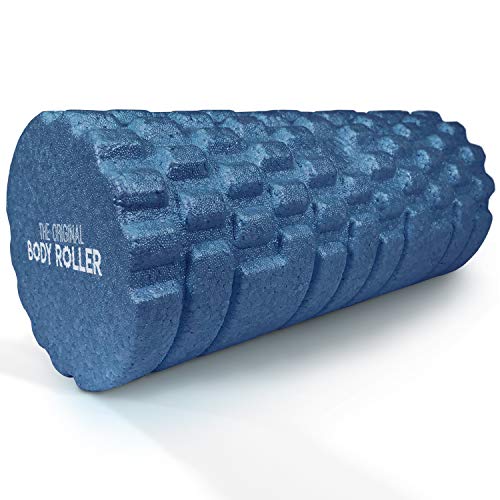
A 0.5 lb, 12.5 in textured roller at an entry price makes this the softest landing for a teen who has never rolled before.
Best for: a first-time roller in a middle-school or freshman gym bag. Skip it if: you already tolerate firm pressure and want more bite.
Two things make this the beginner pick. It weighs 0.5 lb, the lightest textured option here by a wide margin, so a smaller teen can carry it to practice without a second thought. And the manufacturer describes a "3D textured" surface with "triple massage zones" meant to imitate fingers, thumbs and palms, which is exactly the pattern-variety idea that lets a nervous rider find a spot that does not overwhelm. The listing also flags it as "still comfortable enough for a beginner", which matches what the specs suggest: entry price band, moderate texture, modest heft at 5.25 x 12.5 x 5.25 in.
The trade-off against the TriggerPoint is straightforward. The build description is thinner, and there is no published load rating. For a 220 lb parent leaning full weight on it, that gap matters. For a 120 lb ninth grader, it does not.
Pros:
- Lightest of the textured picks at 0.5 lb
- Sits in the entry price band
- Triple-zone texture per the listing
- 12.5 in length fits a small locker
Cons:
- No stated weight capacity
- Lighter build than mid-band picks
- Only one seller lists it
3. RumbleRoller Basic Bumpy Foam Roller — Best for heavy use
A 1.5 lb solid-core roller with a stated 300 lb load claim gives the most confidence for a heavier teen or one who rolls daily.

Best for: a heavier teen or one who rolls hard every day. Skip it if: bumpy textures feel too intense on your calves or IT band.
RumbleRoller is the heaviest of the six at 1.5 lb, on a 5.5 in diameter and 13 in length. The manufacturer says the "solid 3-piece EVA core supports 300 lbs" and "will not break or deform like hollow rollers". Set that alongside the hollow-core TriggerPoint and it is a real distinction: a teen sitting the full weight of their upper body on the roller during thoracic work gets a body that stays round. The surface is uniformly bumpy rather than multi-zone, so the intensity does not vary as you shift position. That is a plus if you want a predictable stimulus, a minus if you were counting on softer spots.
The listing is bare. No release year, no model number, and it is the slowest seller of the six in this set. None of that changes what the physical specs say, but it does leave you with less to compare on paper.
Pros:
- Solid-core build per the listing
- Stated 300 lb load claim
- Firm bumpy texture, uniform across the roller
- 13 in length matches the TriggerPoint
Cons:
- Heaviest here at 1.5 lb
- Uniform bumps mean no gentler zones
- Slowest seller of the set
- Sparse listing detail
4. 321 STRONG Patented 3-Zone Massage Roller — Best for families
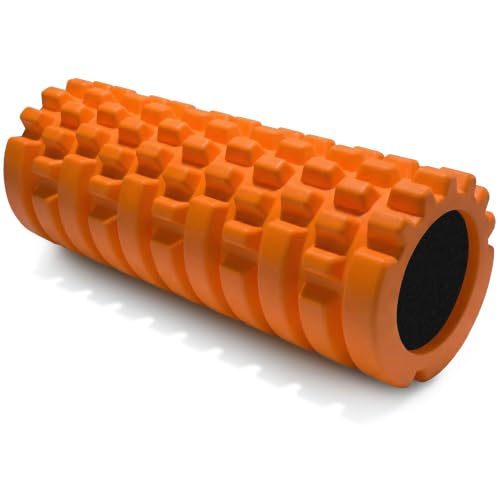
A 0.54 lb medium-density roller with three distinct texture zones and a 300 lb load claim makes it the most shareable pick in the set.
Best for: a household where siblings and parents share one roller. Skip it if: you want a firmer, denser feel for stubborn knots.
Family use is really a range-of-users problem. A 12-year-old on a middle-school soccer team, a 16-year-old cross-country runner and a 45-year-old parent with a stiff lower back all need different pressure from the same roller. 321 STRONG addresses this on the surface itself: smaller projections meant to feel like fingertips, medium ones like thumbs, and the largest to mimic the palm heel. Slide across the length and you change intensity. The listing also states a 300 lb capacity, which matters for the adults, and the roller weighs just 0.54 lb, which matters for a kid throwing it in a duffel.
The trade-off is firmness. It is described as medium density. Where RumbleRoller is aggressively firm and TriggerPoint is firmer than a smooth roller, this one aims for the middle. That is the right choice for a shared household roller. It is the wrong choice if the only user is a strong high-schooler chasing hamstring adhesions.
Pros:
- Three graduated texture zones on one body
- 300 lb capacity claim per the listing
- Very light at 0.54 lb
- BPA-free and wipe-clean per the listing
Cons:
- Medium density, not the firmest here
- 12.5 in body is short for a broad back
- Only one seller lists it
5. Amazon Basics High-Density Foam Roller — Best budget pick
The cheapest of the six, and the only one with a published warranty, but its surface is smooth rather than textured.
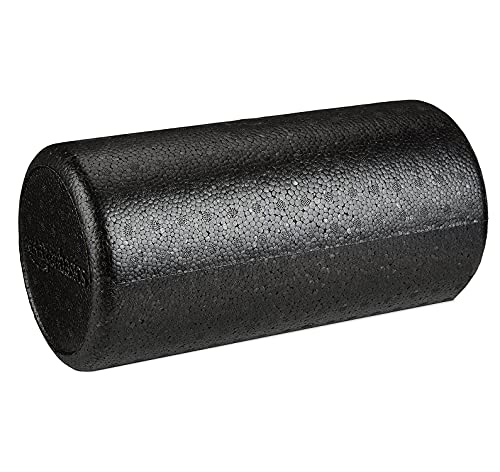
Best for: parents kitting out a first roller without overspending. Skip it if: you specifically want a textured surface, not a smooth one.
I am including this one honestly rather than pretending it fits the keyword. It has no textured surface, per the manufacturer's own description: it is a high-density polypropylene cylinder with molded edges. What earns it a place is the rest of the picture. It is the cheapest of the six, comes with a 30 Day Amazon Guarantee (the only stated warranty in the set), is offered by more than one seller, and weighs a listed 4.32 oz on 6 x 12 x 6 in outer dimensions. For a parent testing whether a young teen will actually use a roller before spending on a Grid or RumbleRoller, that is the sensible starting move.
Read the trade-off plainly. On the keyword's own terms, it fails: no texture. On the wider question of whether it earns a spot in a teen's routine, it passes with room to spare. Pair it with a lacrosse ball for knots and you cover most of what a textured roller does at the cost of one accessory.
Pros:
- Cheapest of the six
- 30 Day Amazon Guarantee, the only stated warranty
- Multiple sellers listed
- Firm polypropylene build per the listing
Cons:
- Smooth surface, not textured
- Does not satisfy the keyword's texture requirement
- Only 12 in of working length
6. JOYVANTAGE Foam Roller — Best premium
A longer 15 in body with multi-density nodules for a taller teen doing serious back and lat work, at the highest price position here.

Best for: a taller teen who wants a longer body for back rolling. Skip it if: you need the lightest option for a packed sports bag.
JOYVANTAGE is the biggest roller here. The listing gives a size of 18*4.7 in and dimensions of 4.7 x 15 x 4.7 in, which means a 15 in working body on a 4.7 in diameter. At 2 lb it is the heaviest of the set. The surface pattern is described as multi-density nodules and ridges with triple grid zones, and the listing cites US Patent Nos. 9,345,921 among others. Structurally, JOYVANTAGE describes premium closed-cell EVA foam over a reinforced PVC core, which is the most explicit build description in this data.
Two honest catches. First, it is the most expensive pick here for what is functionally the same category of surface as the TriggerPoint. The extra length is what you are buying. Second, it is the slowest-selling category entry after RumbleRoller, and no release year is given. For a taller high-schooler who wants their whole thoracic spine covered in one sweep, though, the geometry is the argument, and no other roller in this set matches it.
Pros:
- Longest working body here at 15 in
- 4.7 in diameter for stable rolling
- Multi-density surface with cited patents
- Multiple sellers listed
Cons:
- Most expensive pick here
- Heaviest at 2 lb
- No stated release year
Is a textured roller safe for a 14-year-old?
A textured roller is a general-fitness tool, not a medical device, so the safety question is really about pressure and technique. Three habits keep a young teenager out of trouble.
- Roll slowly. Two to three inches per second, not a bounce.
- Skip joints and bones. Kneecaps, lower back, the sides of the neck, all off-limits.
- Stop on sharp pain. Deep ache is fine, a sudden nerve twinge is not.
A firmer roller like the RumbleRoller is not automatically riskier; it just gives more feedback. A softer one like The Original Body Roller is a gentler introduction. If a teen has a diagnosed injury, a growth-plate concern or ongoing back pain, that is a conversation with a physiotherapist, not a roller purchase.
How long does a foam roller last with daily use?
An EVA-core roller used daily for ten minutes at a time typically holds its shape for two to three years. Signs it is done:
- A flat spot that no longer springs back.
- Ridges or nodules that have sheared off or gone soft.
- A creaking or clicking sound under pressure, which points to a cracked core.
Solid-core builds, like the one RumbleRoller describes, tend to outlast hollow cores because there is no wall to flex. Weight also matters: 321 STRONG and RumbleRoller both cite a 300 lb load capacity, which is a useful proxy for how much punishment the foam has been engineered to take. A 12 in Amazon Basics roller is a lighter-duty tool and reads accordingly.
Head-to-head: TriggerPoint vs RumbleRoller
The most useful comparison in this set is between the top pick and the heavy-use pick, because they represent two philosophies. TriggerPoint gives you a 13 in, 1.1 lb roller with a varied multi-density surface and a hollow EVA core, first released in 2011. RumbleRoller gives you a 13 in, 1.5 lb roller with a uniform bumpy surface and a solid EVA core rated to 300 lb.
TriggerPoint wins for range. The mix of ridge and nodule sizes means one roller serves a first session and a fifth month. RumbleRoller wins for durability signal. A stated load claim and a solid-core description are more reassurance for a heavier user than a hollow-core design carries. The tiebreaker for most teens is the varied surface. A 14-year-old will not want the same intensity on their calves as their glutes, and TriggerPoint gives that choice on one tool.
If the specific user is a bigger, stronger teenager rolling every day and probably sharing with a parent, flip the recommendation.
What the listings do not tell you
Two things a foam roller listing rarely shows.
- How loud it is on a wood floor. Firm rollers on bare hardwood make a distinct grinding sound. A rug or a yoga mat solves it.
- How it stores. A 15 in roller does not fit inside most gym bags without dominating the space. Under-bed or closet-shelf storage is the honest answer.
None of the six listings gives a decibel figure or a bag-fit note. Both matter more for a teen sharing a bedroom or hauling gear to school than any of the specs actually printed on the page.
The verdict
The TriggerPoint Grid 1.0 is the best textured foam roller for teens for the same reasons it has stayed on shelves since 2011: a 13 in EVA body that is firmer than a smooth roller without being punishing, a varied ridge and nodule surface that scales from a first session to a stubborn hip flexor, and a 1.1 lb weight that lands in a school bag without complaint. It is the roller I would put in a 14 to 17-year-old's routine as a default.
Two conditions flip that. First, if the user is a taller or heavier teen working the full thoracic spine, the JOYVANTAGE at 15 in and 2 lb is worth the extra outlay for the geometry alone. Second, if the user is a nervous beginner or a lighter body, the Original Body Roller at 0.5 lb and an entry price is the softer landing that gets used more often, and a roller used four times a week beats a firmer one used twice. The RumbleRoller stays in reserve for heavy daily use where a solid core matters, and 321 STRONG is the correct answer for a shared family shelf.
FAQ
Is a textured foam roller better than a smooth one for teens?
A textured foam roller is better than a smooth one when the goal is targeted pressure on knots and tight fascia, which describes most teen recovery needs after sport. A smooth roller is calmer and cheaper, and it is a fair starter tool, but it is essentially a firm cylinder. The ridges and nodules on picks like the TriggerPoint Grid 1.0 or JOYVANTAGE let the user vary intensity without changing tool.
What size foam roller should a teen buy?
The size a teen should buy tracks with height and use case. A 12 to 13 in roller, like the TriggerPoint Grid 1.0 at 13 in or the 12.5 in Original Body Roller, handles calves, quads and glutes and fits in a locker. A 15 in body like the JOYVANTAGE covers a broader back in one sweep and suits taller users. Diameter matters too: a 5 to 5.5 in roller is the standard, comfortable range.
Is the TriggerPoint Grid 1.0 worth the money for a teenager?
The TriggerPoint Grid 1.0 is worth the money for a teenager who will roll two to three times a week for a year or more. The multi-density surface scales with use, the 1.1 lb weight suits a gym bag, and the design has been on sale since 2011, so replacement rollers and technique videos are easy to find. For a teen who has not tried rolling yet, an entry-band roller is the smarter first move.
TriggerPoint Grid 1.0 or 321 STRONG for a family with a young teen?
TriggerPoint Grid 1.0 or 321 STRONG comes down to who else uses it. Choose 321 STRONG if a parent, a sibling and the teen all share one roller: three graduated texture zones, a 300 lb load claim per the listing, and medium density suit a wider range of bodies. Choose TriggerPoint if the roller is primarily the teen's, because its firmer EVA-over-hollow-core build gives a deeper signal on tight muscles.
What is the biggest mistake buying a textured foam roller for teens?
The biggest mistake buying a textured foam roller is chasing tall, aggressive nodules on a soft body of foam. Dramatic bumps on soft foam collapse under pressure and deliver a spongy, unfocused stimulus. Look for the density and construction claim first, texture pattern second. TriggerPoint states an EVA foam wrap over a hollow core, RumbleRoller states a solid three-piece EVA core to 300 lb, and 321 STRONG states a closed-cell EVA build.
Start with the roller that matches how the teen will actually use it. A daily user chasing hip and back tightness gets more out of the TriggerPoint Grid 1.0 than any other pick here, because the varied ridge pattern grows with them from a tentative first session to fifteen minutes of focused work. A twice-a-week user is better served by the Original Body Roller, which is lighter, cheaper, and less likely to sit unused because it looked intimidating. Whatever roller lands in the bedroom, put a rug under it and pair it with a five-minute after-practice window. The tool is only as good as the habit around it.