Best Foam Rollers by Density, Length and Texture

Six foam rollers compared on the two figures that actually decide comfort: length and surface texture. Includes who should skip the textured models entirely.

By Alicia RoseUpdated 18 min read
On this page
- Best foam roller for men over 50 at a glance
- How I screened this field down to six rollers
- Why length decides more than density does
- 1. 321 STRONG Patented 3-Zone Massage Roller — Best overall
- 2. TriggerPoint Grid 1.0 Foam Roller — Runner-up
- 3. Amazon Basics High-Density Foam Roller — Best for pros
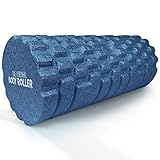
- 4. The Original Body Roller — Best for beginners
- 5. ProsourceFit High Density Foam Roller — Best budget pick
- 6. FITINDEX Vibrating Foam Roller — Best premium
- Does a foam roller for men over 50 need to be textured?
- What the listings do not tell you about firmness
- Which foam roller for men over 50 fits your routine?
- The verdict
- FAQ
The best foam roller for men over 50 is the 321 STRONG Patented 3-Zone Massage Roller, because its three-zone surface lets you dial pressure down on a sore hip instead of committing to one intensity across a 12.5 in barrel. If you want to lie back and roll your whole spine in a single pass, the 18 in Amazon Basics High-Density Foam Roller is the better buy at 0.6 lb.
This one isn't for you if you're already rolling daily and want a therapist-grade tool with published durometer numbers. Those exist, and none of them are here. This set is six mainstream rollers, five of them plain foam or EPP, one motorised, none of them marketed at any age group. If that's what you were hoping for, a physical therapist's recommendation beats any roundup.
Best foam roller for men over 50 at a glance
| Pick | Length | Surface | Price |
|---|---|---|---|
Best overall 321 STRONG Patented 3-Zone Massage Roller |
12.5 in | 3 textured zones | Check Price |
Runner-up TriggerPoint Grid 1.0 Foam Roller |
13 in | Grid ridges, hollow core | Check Price |
Best for pros Amazon Basics High-Density Foam Roller |
18 in | Smooth, moulded edges | Check Price |
Best for beginners The Original Body Roller |
12.5 in | 3D texture, 3 zones | Check Price |
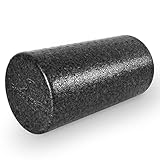
Best budget pick ProsourceFit High Density Foam Roller |
12 in | Smooth EPP | Check Price |
Best premium FITINDEX Vibrating Foam Roller |
11.4 in | Textured, 5 speeds | Check Price |



How I screened this field down to six rollers
I started with the published specifications and nothing else. Length, diameter, weight, surface construction, material. Those are the figures a listing actually commits to, and they're the ones you can compare down a column without trusting anyone's adjectives.
Six survived. Here's what the numbers show once you line them up:
- Length spans 11.4 in to 18 in. That's a 6.6 in gap, and it changes what body parts you can reach.
- Weight spans 0.28 g to 3.11 lb. The vibrating model is roughly three times heavier than the next-heaviest pick.
- Diameter is nearly uniform. Five of the six sit between 4.7 in and 6 in, so height off the floor barely varies.
- Four are textured, two are smooth. That split matters more than brand.
- Only one needs charging. Everything else works forever with no maintenance beyond a wipe.
- Two publish a release year, 2011 and 2018. The rest don't say.
What got cut: rollers with no published dimensions, and anything where the listing described feel without giving a length. If a listing won't tell me how long the barrel is, I can't tell you whether it reaches your mid-back.
One honest limit. No product here publishes a firmness rating, a durometer figure or an age guideline. Nothing in this data says any roller is designed for older users. So I'm comparing what the listings actually state and letting you match it to your own stiffness.
Why length decides more than density does
Most guides to the best foam roller for men over 50 lead with density. Soft, medium, firm. That's the wrong first question.
Length decides whether you can use the thing at all. On an 18 in barrel you lie perpendicular across it and roll the whole thoracic spine without your shoulders sliding off either end. On a 12 in barrel you can't. You get a good hip and quad tool and a mediocre back tool, because the roller keeps rotating out from under one shoulder blade.
That's the actual fork in this category. Two picks here are 18 in and 13 in. Three cluster around 12 to 12.5 in. One is 11.4 in.
Here's the trick with the shorter models: they're better at limbs. A 12.5 in roller under one calf gives you far more control than a long barrel that wants to sit under both. If your problem is hamstrings, IT bands and glutes, short wins. If it's a stiff upper back after a desk day, long wins.
Density comes second, and it's not a number anyone here publishes. What you get instead is material and construction:
- High-density EPP or polypropylene, on the Amazon Basics and the ProsourceFit. Solid, firm, no give.
- EVA foam over a hollow core, on the TriggerPoint. The listing calls it firmer than traditional foam rollers.
- Moulded texture with varied projection heights, on the 321 STRONG and The Original Body Roller. Pressure changes by where you position yourself, not by what you bought.
That last one is why the winner wins. Adjustable intensity beats a fixed guess at what your hips can take today.
1. 321 STRONG Patented 3-Zone Massage Roller — Best overall
Three distinct textured zones on one 12.5 in barrel mean you choose the intensity mid-session instead of committing to it at checkout.
Best for: someone rolling stiff hips and quads who wants pressure control Skip it if: you need a roller long enough to span your whole back
Within this set, the 321 STRONG is the pick that solves the firmness problem without asking you to guess. The surface carries three zones of different projection sizes. 321 STRONG describes the smallest as mimicking a therapist's fingertips and the larger ones as mimicking thumbs and palms. Shift your body 4 in along the barrel and the pressure changes. That matters when one hip is tender and the other isn't.
The dimensions are 5.5 x 12.5 x 5.5 in and it weighs 0.72 lb, so it's a one-hand carry to the living room floor. The 5.5 in diameter is standard, which means every rolling position you've seen demonstrated will work. The listing describes it as medium density, which lands it between the hard EPP picks and nothing softer in this group.
It sells faster than every pick here except the Amazon Basics, which tells you the three-zone format has found its audience. The trade-off against the 18 in option is real, though: at 12.5 in you're rolling one side of your back at a time, or one leg at a time. That's more control and more repetitions.
Pros:
- Three intensity zones on a single barrel
- 12.5 in length gives precise single-limb control
- Light at 0.72 lb
- Standard 5.5 in diameter suits common rolling positions
- One of the two fastest movers in this set
Cons:
- Too short to span the full thoracic spine
- Textured surface is more aggressive than smooth foam on a first session
- No published firmness or load rating
- Only one seller lists it
2. TriggerPoint Grid 1.0 Foam Roller — Runner-up
A hollow core wrapped in EVA foam that has been on the market since 2011, the longest published track record in this group.

Best for: regular users who want a hollow core that holds its shape Skip it if: you want the softest possible first session
The TriggerPoint Grid is 13 in long and weighs 1.1 lb, the second-heaviest pick here. That weight comes from the EVA foam wrap rather than solid fill, because the centre is hollow. TriggerPoint says the construction is firmer than traditional foam rollers and that it maintains its shape even after repeated use.
The grid pattern is the differentiator. Rather than three separate zones, you get a repeating layout of ridges and channels across the whole surface. The channels are the point: TriggerPoint describes them as promoting tissue aeration and blood flow as you roll. In practice you're getting narrower contact strips than a smooth roller gives, which concentrates pressure whether you wanted that or not.
Its 2011 release date is the oldest here by seven years. A design that's still selling well over a decade later has answered the durability question in the only way that counts.
The trade-off is straightforward. This is the firmer of the two premium-priced picks and the least forgiving surface in the set on tender tissue. If you haven't rolled in years, start on something blunter and graduate to this.
Pros:
- Hollow core resists compression over time
- 13 in barrel covers more than the 12 in picks
- Longest published market history at 2011
- Grid channels concentrate pressure precisely
Cons:
- Firmest surface here on already-sore muscles
- One of the two most expensive picks in this set
- No published density or durometer figure
- Only one seller lists it
3. Amazon Basics High-Density Foam Roller — Best for pros
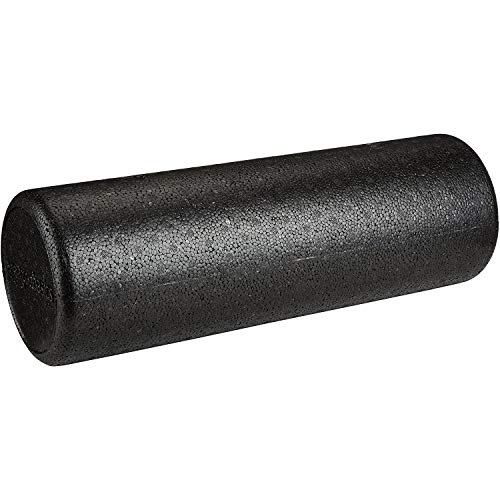
At 18 in it's the only roller here long enough to lie across and roll your entire upper back in one uninterrupted pass.
Best for: anyone rolling the full length of the spine or doing balance work Skip it if: flat high-density foam feels too blunt on your hamstrings
This is the outlier, and it's the outlier in the way that matters most. Every other pick sits between 11.4 in and 13 in. This one is 18 in, a 5 in advantage over the next longest. Lie perpendicular across it and both shoulder blades stay supported while you roll from mid-back to shoulders. That single capability is worth more to a stiff upper back than any texture pattern.
It's also the lightest here at 0.6 lb, in a 6 x 18 x 6 in body of firm polypropylene. Amazon Basics says the moulded edges add comfort and that it wipes clean easily. The 6 in diameter is the largest in the set, which lifts you slightly higher off the floor and opens up more supported stretch positions.
It's the fastest-moving pick of the six by a wide margin, and it sits in the lower price bracket, second-cheapest here. That combination of length and position is hard to argue with.
The cost is precision. A smooth 18 in barrel can't isolate a single calf the way a 12.5 in textured roller can, and the flat surface delivers one uniform pressure with nowhere gentler to move to.
Pros:
- 18 in length, the only pick that spans the full back
- Lightest here at 0.6 lb
- 6 in diameter supports more stretch positions
- Second-cheapest in this set
- The one buyers choose most often here
Cons:
- Smooth surface offers no intensity variation
- Too long for precise single-limb work
- Firm polypropylene with no give at all
- No published weight capacity
4. The Original Body Roller — Best for beginners
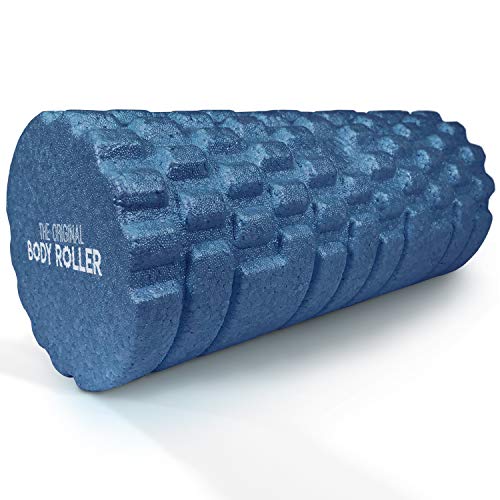
Three-zone texture in a 0.5 lb body, the lightest textured roller here and the least intimidating way into the category.
Best for: a first roller when you don't know how much pressure you can take Skip it if: you want a published firmness or load figure before buying
The Original Body Roller measures 5.25 x 12.5 x 5.25 in and weighs 0.5 lb. That makes it the lightest textured pick here and lighter than every roller in the set except the Amazon Basics. Weight isn't a performance figure on a foam roller, but it does tell you how easy it is to grab off a shelf and drop on the carpet.
Like the 321 STRONG, it uses three massage zones. The brand describes them as replicating the fingers, thumbs and palms of a hand, and says the EPP construction is tough enough for athletes while staying comfortable enough for a beginner. Its 5.25 in diameter is the second-smallest here, which sits you a touch lower to the floor and makes it slightly easier to get on and off without a wall for support.
That last detail is why I'd hand this one to somebody starting fresh. Lower barrel, light body, adjustable zones, mid-range price position.
Against the 321 STRONG it loses on two counts: it's the slower seller of the two three-zone designs, and the listing publishes no count field, so a multi-pack buyer has less to go on. It's also the only pick here with no stated size variant in the specifications.
Pros:
- Lightest textured roller here at 0.5 lb
- Three zones let you moderate pressure
- 5.25 in diameter is easy to get down onto
- Mid-range price position rather than premium
Cons:
- No published count or size specification
- Slower seller than the similar 321 STRONG
- Firmness described only in words, never a figure
- Only one seller lists it
5. ProsourceFit High Density Foam Roller — Best budget pick
The cheapest of the six and the only one here with a published weight capacity, at 300 lb.

Best for: travel, hotel rooms and a second roller for the office Skip it if: you want texture or a longer barrel
Two things make the ProsourceFit worth a look beyond its price position. It's the cheapest pick here, and it's the only listing in the set that publishes a load figure: ProsourceFit states a 300 lb maximum weight capacity. Every other brand describes firmness in adjectives. This one gives a number.
The barrel is 12 x 6 x 6 in, so it's the shortest smooth roller here while keeping the same 6 in diameter as the 18 in Amazon Basics. You get identical floor clearance in a body a third shorter. ProsourceFit says the expanded polypropylene is water-resistant, recyclable and hygienic, which makes it a reasonable gym-bag or poolside roller.
The brand also lists 36 in, 24 in, 18 in and 12 in variants, so if you like the material but need reach, the same product exists longer.
Here's the honest limitation. A smooth 12 in high-density barrel is the bluntest tool in this comparison. It won't reach across your back and it won't isolate a knot the way a textured surface does. What it does is deliver firm, even pressure to one muscle group at a time, cheaply, in something that fits a carry-on.
Pros:
- Cheapest of the six
- Only pick with a published 300 lb capacity
- 6 in diameter matches the longest roller here
- Water-resistant, wipe-clean EPP
- 12 in body fits a carry-on
Cons:
- Shortest smooth roller, no back coverage
- No surface texture at all
- Weight specification published as 0.28 g, which is clearly a listing error
- Only one seller lists it
6. FITINDEX Vibrating Foam Roller — Best premium
Five vibration speeds in an 11.4 in body, the only pick here that adds anything beyond your own body weight.

Best for: stubborn calves and IT bands that don't respond to plain rolling Skip it if: you'd rather not charge a piece of foam
The FITINDEX is the one genuinely different product in this group. It's a 4.72 x 11.4 x 4.72 in textured roller with a motor inside, offering five vibration intensity settings that FITINDEX describes as using frequency conversion technology. It charges over USB-C.
It's also the heaviest pick here by a distance at 3.11 lb, roughly three times the TriggerPoint's 1.1 lb. FITINDEX calls it compact and easy to carry, and by motorised standards that's fair, but next to a 0.6 lb piece of foam it isn't.
Two things recommend it. The 4.72 in diameter is the smallest in the set, which means the lowest starting position of any pick and the least commitment when you lower yourself onto it. And the five settings mean you can start at the gentlest level on tissue that hasn't been rolled in years, then work up.
The costs are equally clear. It's the most expensive pick here, it's the shortest roller of the six, it needs charging, and it's the slowest seller by a large margin. Every other roller in this comparison works for a decade with no battery and no failure point.
Pros:
- Five vibration intensity settings
- Smallest diameter here at 4.72 in, easiest to get onto
- USB-C charging
- Textured surface plus powered assistance
Cons:
- Most expensive pick in this set
- Heaviest at 3.11 lb, over five times the Amazon Basics
- Shortest barrel here at 11.4 in
- Battery adds a failure point no other pick has
- Slowest seller of the six
Does a foam roller for men over 50 need to be textured?
No. And this is where a lot of money gets wasted.
Texture concentrates your body weight onto smaller contact patches. Same weight, less surface area, more pressure per square inch. That's useful on a knotted IT band. It's unnecessary on a mildly stiff quad, and it's actively unpleasant on tissue that hasn't been worked in years.
Four of the six picks here are textured. Two are smooth. Both approaches are legitimate:
- Choose smooth if you're new to rolling, if you're working large areas like the whole back, or if firm even pressure is what you want. The Amazon Basics and the ProsourceFit.
- Choose textured if you have a specific spot that plain rolling doesn't touch, and you want the option to move to a gentler zone. The 321 STRONG and The Original Body Roller both give you that escape route.
- Choose grid if you want texture that's consistent across the entire barrel rather than zoned. The TriggerPoint.
One caution on marketing language. Several listings here describe their surfaces as mimicking a therapist's hands or delivering physical-therapy-grade massage. That's the manufacturer talking about a shape, not a clinical outcome. The 321 STRONG listing also cites a claimed 20% recovery-time reduction from 20 minutes of rolling. Treat that as the brand's claim about published research, not as a specification you can verify from the listing.
What the listings do not tell you about firmness
Every roller here is described as high-density, firm, or medium density. Not one publishes a durometer rating. That's the single biggest gap in this data, and it's worth understanding before you buy any foam roller for men over 50.
What you can infer from what is published:
- Material. Solid EPP or polypropylene, on the Amazon Basics and ProsourceFit, is the firmest construction here. EVA foam over a hollow core, on the TriggerPoint, is described by the brand as firmer than traditional foam.
- Weight relative to volume. A 0.6 lb 18 in roller and a 0.28 lb 12 in roller are both light-for-size, consistent with expanded foam rather than dense rubber.
- Load capacity, where stated. Only ProsourceFit gives one, at 300 lb.
What you can't infer: how it will feel under your hamstring. Nobody can tell you that from a listing, and any roundup claiming otherwise is guessing.
There's a second gap. No pick here publishes a warranty in its specifications. Not one of the six. If a stated guarantee is part of your buying criteria, that's a genuine reason to look outside this set entirely.
Practical workaround: buy the shorter and softer option first if you're unsure. A 12.5 in medium-density textured roller with escape zones gives you room to discover your tolerance. An 18 in slab of high-density polypropylene does not.
Which foam roller for men over 50 fits your routine?
Match the roller to the body part that actually bothers you. Not to the brand.
- Stiff upper back after desk work. The 18 in Amazon Basics. Nothing else here spans your shoulders in a single pass.
- Tight hips and quads after walking or cycling. The 321 STRONG at 12.5 in. Short enough to isolate one side, zoned so you can back off.
- Calves and IT bands that won't release. The FITINDEX, starting on its lowest of five speeds.
- Rolling most days already. The TriggerPoint Grid 1.0. Hollow core, EVA wrap, a design that has survived since 2011.
- First roller, no idea where to start. The Original Body Roller at 0.5 lb and 5.25 in diameter.
- Travel and a second roller for the office. The ProsourceFit at 12 in with its published 300 lb capacity.
The thresholds worth remembering: above 15 in and you're buying a back-and-balance tool; 12 to 13 in and you're buying a limb tool; under 5 in diameter and you're buying the easiest roller to get down onto, which is the FITINDEX at 4.72 in.
Getting on and off the floor is the constraint people underestimate. Diameter and weight matter here more than any feature bullet. A 0.5 lb roller you can reposition with one hand while braced against a couch is more usable than a 3.11 lb powered barrel you have to set up.
The verdict
Three tiers, three answers.
At the entry end, the ProsourceFit is the cheapest pick here and the only one publishing a 300 lb load figure. It's 12 in of smooth high-density EPP with no texture and no back coverage. Buy it for travel or as a second roller. The Amazon Basics sits just above it and is the better single purchase for most people, because 18 in is a capability nothing else here has.
In the middle, the 321 STRONG takes the win. Its three textured zones solve the problem that no listing in this category will solve for you: you don't know how much pressure you can tolerate until you're on the floor. Zoned texture lets you find out session by session instead of at checkout. At 12.5 in and 0.72 lb it's a limb-and-hip specialist, not a back tool, and that's the honest limit. The Original Body Roller offers the same three-zone idea at 0.5 lb and a slightly lower 5.25 in diameter, which makes it the gentler entry into the same format.
At the premium end, the TriggerPoint Grid 1.0 earns its position on construction and a 2011 track record. The FITINDEX earns its position only if vibration is the thing you're specifically after. Five speeds and a 4.72 in diameter against 3.11 lb and a battery.
FAQ
Is a foam roller for men over 50 worth buying at all?
A foam roller for men over 50 is worth buying if stiffness is limiting what you do, and the low cost of the entry picks here makes the experiment cheap. The ProsourceFit and the 18 in Amazon Basics both sit at the affordable end. What a roller can't do is diagnose anything. Persistent joint pain needs a professional, not foam.
Which is better value, the Amazon Basics or the ProsourceFit?
Better value goes to the Amazon Basics, narrowly. The ProsourceFit is the cheapest of the six, but the Amazon Basics is second-cheapest and gives you 18 in of length against 12 in. That extra 6 in is the difference between rolling your whole upper back and rolling half of it. Choose the ProsourceFit only if portability outranks coverage.
What length foam roller should I choose?
The length you choose depends on the target. Pick 18 in, like the Amazon Basics, if you want to lie across the barrel and roll the full thoracic spine or use it for balance work. Pick 12 to 13 in, like the 321 STRONG or TriggerPoint Grid, if you're isolating one calf, hamstring or hip at a time with better control.
321 STRONG or TriggerPoint Grid 1.0: which should I get?
Between the 321 STRONG and the TriggerPoint Grid 1.0, choose by how much firmness you want. The 321 STRONG is medium density with three separate intensity zones, so you can retreat to gentler texture mid-session. The TriggerPoint uses a hollow core under EVA foam that the brand calls firmer than traditional rollers, with grid texture across the whole 13 in surface.
What mistake do first-time foam roller buyers make?
The mistake first-time foam roller buyers make is starting on the firmest, most aggressive surface available. High-density polypropylene and deep texture concentrate a lot of pressure on tissue that hasn't been worked in years, and the result is a roller that sits in a closet. Start with medium density and zoned texture, then move firmer once your tolerance is known.
Pick the length first, then the surface. If your upper back is the problem, get the 18 in Amazon Basics and be done. If it's hips, quads and hamstrings, and you honestly don't know how much pressure you can handle yet, the 321 STRONG is the safer default precisely because it gives you somewhere gentler to move to when a spot turns out to be tender. That escape route is worth more than any density claim on any listing here, because it's the one variable you control after the box arrives rather than before.