Best Commercial Grade Exercise Ball When Space Is Tight

Seven exercise balls compared on published weight ratings, diameter, grip texture and warranty, with a named winner and the conditions that flip the pick to something else.
By Alicia RoseUpdated 19 min read
On this page
- Best commercial grade exercise ball for seniors at a glance
- How I screened this field and what the weights had to prove
- Why weight rating decides this more than diameter does
- What height does the 65 cm size actually suit?
- 1. ProBody Pilates Yoga Ball — Best overall
- 2. Trideer Yoga Ball for Exercise — Runner-up
- 3. APEXUP Yoga Ball — Best for beginners
- 4. ProBody Pilates Ball Small — Best budget pick
- 5. THERABAND Pro Series Exercise Ball — Best for heavy use
- 6. Srsrana Exercise Ball — Best for families
- 7. ProsourceFit Slam Medicine Ball — Best premium
- Does "seniors" appear anywhere in these listings?
- What owning a stability ball actually involves
- When a different pick wins
- The verdict
- FAQ
The best commercial grade exercise ball for seniors is the ProBody Pilates Yoga Ball, a 65 cm ball the maker says is tested to 880 lbs, backed by a 1-year warranty and shipped with its own dual-action pump. If your floors are hard and slippery, the Trideer Yoga Ball for Exercise takes it instead, on the strength of its anti-slip stripes and frosted surface. Most shoppers compare diameter first. Diameter tells you whether the ball fits your legs. It says nothing about whether the shell will hold up under repeated sit-and-stand transfers, which is the part that actually matters.
Best commercial grade exercise ball for seniors at a glance
| Pick | Diameter | Weight rating | Price |
|---|---|---|---|
Best overall ProBody Pilates Yoga Ball |
23-26 in / 58-65 cm | 880 lb claim | Check Price |
Runner-up Trideer Yoga Ball for Exercise |
23-26 in / 58-65 cm | 330 lb claim | Check Price |
Best for beginners APEXUP Yoga Ball |
23-26 in / 65 cm | 660 lb claim | Check Price |
Best budget pick ProBody Pilates Ball Small |
9 in | Not stated | Check Price |
Best for heavy use THERABAND Pro Series Exercise Ball |
26 in / 65 cm | Not stated | Check Price |
Best for families Srsrana Exercise Ball |
23-26 in / 58-65 cm | 330 lb claim | Check Price |
Best premium ProsourceFit Slam Medicine Ball |
9 x 9 x 9 in | 20 lb ball | Check Price |




How I screened this field and what the weights had to prove
I set three criteria before looking at any listing, and I weighted them in this order.
- Published weight rating, weighted heaviest. A stability ball takes its worst load during the transfer, when someone lowers onto it or pushes back up and briefly loads one side. A stated rating is the only number in these listings that speaks to that.
- Slow-deflate construction, weighted second. Every full-size pick here claims it. A ball that fails should sag over seconds, not seconds' fraction. That difference is the whole safety argument for the category.
- Diameter and published warranty, weighted third. Diameter is a fit question you can solve by picking a different size. A warranty is a small signal, but it separates the picks that publish one from those that don't.
Those weights are set that way because two of them are safety and one is convenience. The weight rating and the deflate behaviour are what stand between a user and the floor. Height matching only decides whether the exercise is comfortable.
What that screening exposed: four of the seven publish a weight figure, and they range from 330 lbs to 880 lbs. Four publish a warranty. Two of the seven are not sitting balls at all. I kept both, because the smaller ones do a job the big ones can't, and a reader searching for the best commercial grade exercise ball for seniors is often shopping for two things at once.
Why weight rating decides this more than diameter does
Diameter is the number every listing leads with. It's easy to compare and easy to get right. It's also not the number that decides a purchase in this category.
Here's the trick with a stability ball. Steady sitting spreads load across a wide contact patch. The transfer does not. When someone lowers onto the ball with a hand on a chair and shifts weight onto one hip, the shell takes a concentrated load well above bodyweight for a second or two. That repeats every session, for years.
Published ratings in this set: 880 lbs for the ProBody, 660 lbs for the APEXUP, 330 lbs for both the Trideer and the Srsrana. That is a spread of 550 lbs across four listings that look nearly identical in the photos. The gap is the margin, and margin is what you're buying when you look for the best commercial grade exercise ball for seniors rather than a generic yoga ball.
The other half of the answer is deflate behaviour. ProBody, Trideer, APEXUP, Srsrana and THERABAND all describe slow air release or slow deflation. That's the pattern to insist on. A ball with no such claim on its listing is not worth the risk for seated use, whatever its diameter.
What height does the 65 cm size actually suit?
Every full-size pick here lands in the same band, and that band is not universal.
- ProBody Pilates Yoga Ball: 23-26 in / 58-65 cm
- Trideer Yoga Ball for Exercise: 23-26 in / 58-65 cm
- APEXUP Yoga Ball: 23-26 in, 65 cm
- Srsrana Exercise Ball: 23-26 in / 58-65 cm
- THERABAND Pro Series Exercise Ball: 26 in / 65 cm
THERABAND is the only listing that publishes a height range for its ball, stating the 26 in size suits users 5'7" to 6'1". Read that as the reference point for the whole group, because the other four sit in the same diameter band. If you're under 5'7", a 65 cm ball will sit your hips above your knees, and that is the wrong geometry for a seated hold.
APEXUP is the pick that solves this directly. Its listing states five sizes from 45 to 85 cm, and it tells you to check the size guide before ordering. That's the honest instruction, and it's why APEXUP carries the beginner label here. Buying a ball two sizes too big is the single most common mistake in this category, and it's not recoverable by inflating it less.
1. ProBody Pilates Yoga Ball — Best overall
The highest published weight rating in this set, in the standard 65 cm size, with a pump and a 1-year warranty in the box.
Best for: someone who wants the highest published weight rating in a 65 cm ball Skip it if: you are shorter than about 5'7" and need a smaller diameter
ProBody's number is the one that separates it. The listing says the thick non-toxic PVC is tested to 880 lbs, which is 220 lbs above the next-highest claim in this group and 550 lbs above the two 330 lb picks. ProBody also states that a punctured ball deflates slowly rather than bursting, and describes that as the pattern physical therapy clinics look for. Take the clinic framing as marketing. Take the deflate behaviour as the feature you want.
The practical details are good too. It ships with a dual-action pump, so you're not hunting for one, and the whole thing weighs 2.2 lb with a packed size of 5.5 x 8.5 x 10 in. That matters if the ball has to live in a closet between sessions. The 1-year manufacturer warranty puts it alongside three others here that publish one.
Its trade-off is size. At 23-26 in / 58-65 cm, it comes in one diameter, so a shorter user has no smaller option under this listing. It also sits toward the top of the price range here, and it's the only ball in the set where a single seller is listed.
Pros:
- Highest published weight rating in this group, 880 lb claim
- Slow-deflate construction rather than sudden burst
- Dual-action pump included, no separate purchase
- 1-year manufacturer warranty published
- Packs to 5.5 x 8.5 x 10 in for storage
Cons:
- Single diameter only, no smaller size on this listing
- Toward the top of the price range here
- Only one seller lists it
- No published height range to match against
2. Trideer Yoga Ball for Exercise — Runner-up
The grip-focused pick, and the one buyers choose most often in this set.

Best for: hard floors where slip is the main worry Skip it if: you need a rating above 330 lbs
Trideer builds its case on surface, not on load. The listing describes anti-slip stripes plus a fine frosted texture, and says the added friction keeps contact safe against both the floor and your body. On tile, sealed hardwood or vinyl plank, that is the failure mode you're actually guarding against. A ball that skates six inches out from under someone mid-transfer is a bigger risk than a shell that gives out, and no amount of weight rating fixes it.
It's also the fastest seller of the seven, which tells you something about how well the fit works out for people who order it. The stated rating is 330 lbs with burst-resistant structure and slow air release. The kit is generous: a quick-inflation pump matched to the size, two air stoppers, and instructions. Size is 23-26 in / 58-65 cm, weight 2.2 lb, and there's a 1-year warranty.
The trade-off against the ProBody is blunt. The rating is 550 lbs lower, and for a ball meant to take repeated seated transfers, that's the number I'd rather have high.
Pros:
- Anti-slip stripes plus frosted texture for hard floors
- Sells faster than the rest of this set
- Pump, two air stoppers and instructions included
- 1-year warranty published
- Light at 2.2 lb
Cons:
- 330 lb claim is the joint-lowest here
- Single diameter band on this listing
- No published height range
- No packed dimensions listed for storage planning
3. APEXUP Yoga Ball — Best for beginners
The only pick that lets you match diameter to height across five sizes, at the second-cheapest position here.

Best for: picking a diameter to match your height across five options Skip it if: you want a published warranty
Getting the diameter right is the first thing a new buyer gets wrong, and APEXUP is the listing built around fixing that. It states five sizes from 45 cm to 85 cm, notes that the larger sizes suit taller users while a compact 55 cm works for average adults, and tells you outright to check the size guide before ordering. That instruction is worth more to a first-time buyer than any feature claim on the page.
The safety numbers are strong for the price position. APEXUP describes a honeycomb PVC shell holding 660 lbs with slow deflation if punctured, second only to ProBody's figure in this group. It also claims an anti-slip textured surface for stability on hard floors. The version compared here is the 23-26 in, 65 cm size in black, weighing 2 lb, which ties it with THERABAND as the lightest full-size ball in the set.
Where it gives ground: this is the only full-size pick with no published warranty and the shortest specification list of the seven. No dimensions, no warranty term, nothing on the pump beyond the title. You're trading paperwork for a good rating at a low price position.
Pros:
- Five sizes from 45 to 85 cm for height matching
- 660 lb claim, second-highest here
- Honeycomb shell with slow-deflate behaviour
- Second-cheapest of the seven
- Ties as the lightest full-size ball at 2 lb
Cons:
- No published warranty, unlike four others here
- Shortest specification list in the set
- No packed dimensions published
- Anti-slip claim is stated, not quantified
4. ProBody Pilates Ball Small — Best budget pick
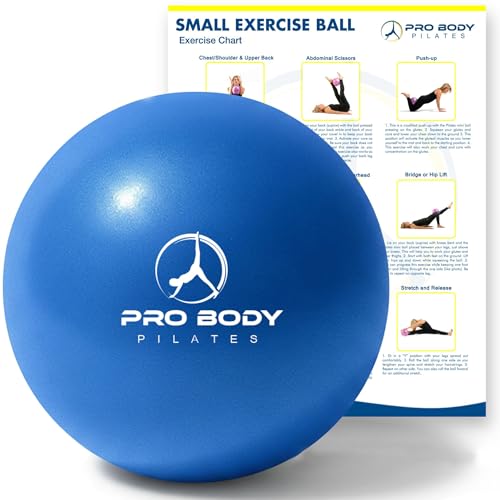
A 9 in therapy ball for seated squeezes and small-range core work, and the cheapest thing here by a wide margin.
Best for: seated squeezes and small-range core work Skip it if: you want a ball you can sit on
This is not a stability ball, and that's the point. At 9 in across and 3.2 oz, it's a therapy ball you hold, squeeze or brace against. ProBody says the 9-inch diameter is what clinics stock because it stays put between adult-sized knees and holds firm-but-yielding pressure for 30 seconds or more without grip fatigue. That specific job, an inner-thigh squeeze from a chair, is one many people in this category are actually looking for.
The case for it as a first purchase is stronger than it looks. Every exercise it supports happens seated or lying down, with no transfer onto an unstable surface. There's no height matching to get wrong. It ships flat at 0.79 x 5.91 x 3.15 in, so it stores in a drawer, and it carries the same 1-year manufacturer warranty as the brand's full-size ball.
Its limits are real. No weight rating is published, because sitting on it isn't the use case. It doesn't replace a 65 cm ball for balance work, seated bouncing or a ball chair setup, and it needs inflating by mouth or with a straw rather than a supplied pump.
Pros:
- Cheapest of the seven by a clear margin
- 9 in size holds position between adult knees
- Just 3.2 oz, stores flat in a drawer
- 1-year manufacturer warranty published
- No height matching required
Cons:
- Cannot be sat on, so it replaces nothing
- No published weight rating
- No pump mentioned in the listing
- Only one seller lists it
5. THERABAND Pro Series Exercise Ball — Best for heavy use
The only ball here that publishes a height range, from the brand most people recognise from a clinic.
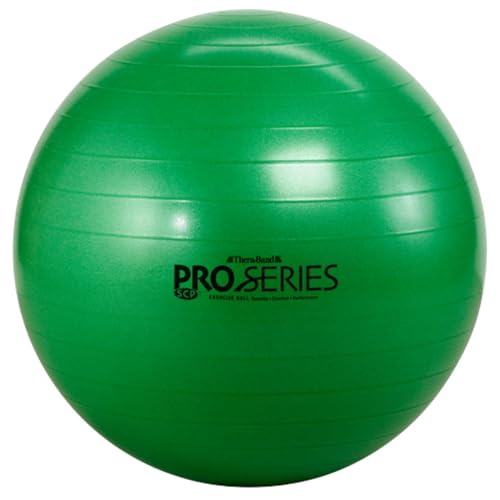
Best for: shared or clinic-style use where the brand matters Skip it if: you want a stated weight rating and a warranty
THERABAND does one thing no other listing here does: it tells you who the ball fits. The 26 in / 65 cm size is stated to suit users 5'7" to 6'1", which is the single most useful line in any of these seven listings. If you're inside that range, you can order without measuring. If you're not, you've been told.
The rest of the listing leans on durability language. THERABAND describes a slow-deflate ball made from burst-resistant material, with easy-to-follow inflation instructions, and says it wipes clean with a damp cloth. That last detail is more relevant than it sounds for a ball shared between people or used in a garage. It's 2 lb, packs to 9.69 x 5.2 x 8.23 in, and comes in green.
The gaps are what cost it position. No weight rating appears anywhere in the listing, which is a strange omission from the most clinical brand in the group and leaves the durability case resting on adjectives. No warranty is published either. It's also the most expensive full-size ball here, and the slowest seller of the seven. You're paying for the name and the height range, not for numbers.
Pros:
- Only listing publishing a height range, 5'7" to 6'1"
- Slow-deflate, burst-resistant construction described
- Wipes clean with a damp cloth
- Ties as the lightest full-size ball at 2 lb
- Packed dimensions published for storage
Cons:
- No published weight rating at all
- No stated warranty, unlike four others here
- Most expensive full-size ball in this set
- Slowest seller of the seven
- No pump mentioned in the listing
6. Srsrana Exercise Ball — Best for families
The most complete kit here, with a resistance band added to the usual ball-and-pump bundle.

Best for: two people sharing one ball plus a band Skip it if: you want the lightest ball to move around
Srsrana is the only pick that puts a second training tool in the box. Alongside the fast-inflation pump, the listing includes a figure-8 resistance band described for upper-body toning and posture work. In a household where one person wants seated core work and another wants arm exercises, that's two people served by one purchase, without a second order.
The ball itself reads much like the Trideer. Srsrana states a professional honeycomb structure rated to 330 lbs with slow deflation if punctured, and a matte surface with 360° anti-slip ridges for traction. Material is described as non-toxic, BPA-free PVC. Size is 23-26 in / 58-65 cm in blue, with a 1-year warranty. It's positioned third-cheapest of the seven.
Two things hold it back. At 3.11 lb it's the heaviest full-size ball here, close to a pound above the 2 lb picks, and that's noticeable if it gets carried between rooms daily. It's also among the slower sellers in this group, and its 330 lb rating sits at the bottom of the four published figures.
Pros:
- Figure-8 resistance band included alongside the pump
- 360° anti-slip ridges on a matte surface
- Honeycomb shell with slow-deflate behaviour
- 1-year warranty published
- Third-cheapest of the seven
Cons:
- Heaviest full-size ball here at 3.11 lb
- 330 lb claim ties for lowest in the set
- One of the slower sellers of the seven
- No packed dimensions published
7. ProsourceFit Slam Medicine Ball — Best premium
A 20 lb sand-filled slam ball with a limited lifetime warranty, for standing strength work rather than balance.

Best for: standing power work, not balance or seating Skip it if: you want anything you can sit or lie on
This one belongs to a different category, and I've kept it because it answers the question the stability balls can't. It's a 20 lb sand-filled ball measuring 9 x 9 x 9 in, with a tire-tread textured PVC rubber shell for grip. ProsourceFit says the sand fill minimises bouncing and rolling, and that the shifting dead weight forces you to stabilise through the whole movement.
The safety logic is inverted from the rest of the set. A stability ball is safe because it deflates slowly. A slam ball is safe because it does not travel. Drop it and it stays where it lands, which matters in a small room. ProsourceFit also notes the range runs 5 to 50 lb and recommends starting at 10-15 lb for new users, plus lighter weights for rehab and coordination work. The 20 lb version here is not the entry point.
It carries the only limited lifetime warranty in this group, against 1-year terms elsewhere. It's also the most expensive pick here, and the mismatch is real: 20 lb is a lot to pick up repeatedly, and no seated, balance or ball-chair use is possible with it.
Pros:
- Limited lifetime warranty, the longest term here
- Sand fill stops bouncing and rolling
- Tire-tread grip surface for wet hands
- Range spans 5 to 50 lb, lighter options exist
- Compact 9 x 9 x 9 in footprint
Cons:
- Cannot be used for seated, balance or chair work
- 20 lb is heavy to handle repeatedly
- Most expensive pick in this set
- Maker suggests 10-15 lb for newcomers, not 20 lb
Does "seniors" appear anywhere in these listings?
No, and you should know that before you buy. None of these seven listings describes itself as designed for older adults, and none publishes a specification aimed at that group. Amazon's search returned general-purpose stability balls, and the published data supports general-purpose claims only.
What the listings actually name as their intended uses: yoga, Pilates, balance training, core work, active sitting as a desk chair replacement, pregnancy and labour support, and physical therapy homework. ProBody and ProBody's small ball both reference clinic protocols. ProsourceFit mentions rehab and coordination work among its uses.
So the "seniors" part is a judgment you have to make yourself, and here's how I'd make it:
- Ask about the transfer, not the exercise. Is there a solid chair, wall or rail within arm's reach of where the ball will sit? If not, the ball is the wrong tool regardless of which one you pick.
- Take the height range seriously. THERABAND's 5'7" to 6'1" statement is the only published guidance here. Below that, use APEXUP's smaller sizes.
- Check with whoever manages the exercise plan. Balance work carries fall risk, and nothing on an Amazon listing substitutes for that conversation.
Read the picks as balls that could serve this use, screened on the safety numbers that matter for it, not as products certified for it.
What owning a stability ball actually involves
Nobody mentions the maintenance, so here it is.
Inflation is a two-stage job. Inflate to about 80% of full size, leave it a day for the PVC to stretch, then top it up. Skip that and the ball goes soft within a week and you'll assume it's leaking. Four of the seven listings mention an included pump: ProBody, Trideer, APEXUP and Srsrana. THERABAND mentions inflation instructions but no pump. Plan for a pump if you pick THERABAND or the small ProBody ball.
Firmness is adjustable, and lower is not always safer. A softer ball sinks further and drops your hips below your knees, which undoes the point of a seated hold. Firmer is more stable to sit on, less forgiving to fall onto. Set it so your hips sit level with or slightly above your knees.
Grit is the enemy. Every puncture I'd expect comes from something on the floor, not from the load. Sweep first. THERABAND is the one that explicitly says it wipes clean with a damp cloth, which is worth doing weekly on any of them.
Storage decides whether it gets used. ProBody publishes a packed size of 5.5 x 8.5 x 10 in and the small ball 0.79 x 5.91 x 3.15 in. Inflated, a 65 cm ball is a large object in a room. If it has to be deflated and re-pumped each time, it will stop getting used by week three.
When a different pick wins
Three specific conditions flip the recommendation away from ProBody, and each one is checkable in a minute.
- You're under 5'7". Then diameter beats weight rating, and APEXUP wins on its five sizes from 45 to 85 cm. A 65 cm ball is too tall, full stop.
- Your floor is tile, vinyl or sealed hardwood with no rug. Then Trideer wins on the anti-slip stripes plus frosted texture, and Srsrana is close behind with its 360° ridges. Slip beats shell strength as the failure mode you'll actually meet.
- You want seated exercise with zero transfer risk. Then the 9 in ProBody Pilates Ball Small wins outright. Everything it does happens from a chair.
Two further flips worth naming. If the ball is shared and you want the height guidance in writing, THERABAND's published 5'7" to 6'1" range is the only one you'll get. If you want power work with a dead weight rather than balance work on an unstable one, ProsourceFit's 20 lb slam ball is the answer, and its limited lifetime warranty is the longest term in this group.
The verdict
Split this by what you're paying for, because the three price tiers here buy genuinely different things.
At the entry end, the money buys fit and flexibility. APEXUP gives you five diameters from 45 to 85 cm and a 660 lb claim, which is more rating than either 330 lb ball above it in price. The small ProBody ball, cheapest here, buys a 9 in therapy ball you use from a chair with no transfer at all. Neither tier-one pick feels compromised on safety.
In the middle, the money buys grip and kit. Trideer adds anti-slip stripes, a frosted surface, two air stoppers and a 1-year warranty, and it's the one buyers choose most often here. Srsrana adds a figure-8 resistance band for a second user, at the cost of the heaviest body in the set at 3.11 lb.
At the premium end, ProBody is the winner and the one I'd default to. Its 880 lb claim is 220 lbs above anything else here, the dual-action pump is in the box, and the 1-year warranty is published. That margin is what "commercial grade" should mean. THERABAND, also premium, buys you a published height range and a recognisable name but no stated weight rating, which is the trade I would not make. Trideer's exact advantage over ProBody is surface friction, and on slick floors that's worth more than 550 lbs of headroom.
FAQ
Is the best commercial grade exercise ball for seniors worth buying over a regular chair?
The best commercial grade exercise ball for seniors is worth it only if there's a stable handhold beside it. Used that way, seated work on a 65 cm ball engages the core continuously in a way a chair cannot. Without a chair, wall or rail within reach, the transfer risk outweighs the benefit, and a 9 in therapy ball used from a chair is the safer buy.
What does more money actually buy in this category?
More money actually buys margin and accessories, not a bigger ball. The premium ProBody adds an 880 lb claim, 220 lbs above the next figure, plus a dual-action pump and a 1-year warranty. THERABAND's premium position buys brand recognition and a published 5'7" to 6'1" height range. Meanwhile the entry-priced APEXUP publishes a 660 lb rating, so a low price does not mean a weak shell.
How do I choose a size for a commercial grade exercise ball?
To choose a size, match diameter to height rather than to bodyweight. THERABAND publishes the only guidance here: its 26 in / 65 cm ball suits users 5'7" to 6'1". Under that height, use APEXUP's smaller options from its 45 to 85 cm range. Seated, your hips should sit level with or slightly above your knees. Too large is not fixable by underinflating.
ProBody or Trideer: which should I pick?
Between ProBody or Trideer, the floor decides. ProBody claims 880 lbs against Trideer's 330 lbs, so it wins on load margin for repeated sit-and-stand transfers. Trideer wins on surface, with anti-slip stripes and a frosted texture that hold better on tile, vinyl or sealed hardwood. Both weigh 2.2 lb, share the 23-26 in band and publish a 1-year warranty, so grip versus rating is the whole choice.
What's the biggest mistake buyers make with exercise balls?
The biggest mistake buyers make is inflating to full size in one go. PVC stretches, so a ball pumped hard on day one feels soft by day three and gets returned as faulty. Inflate to roughly 80%, wait 24 hours, then top up. The second mistake is placing the ball on a gritty floor, since debris causes more punctures than load ever does.
Start with the height check, because it costs nothing and it's the mistake you can't undo. If you're between 5'7" and 6'1", order the ProBody Pilates Yoga Ball and be done: the 880 lb claim, the included pump and the 1-year warranty make it the safest default in this group by the numbers actually published. Below that height, APEXUP's size range solves the problem the winner can't. And if the plan is seated exercise with a solid chair rather than balance work on an unstable surface, the 9 in ProBody ball does that job for less than any of them.