Best Budget Balance Board: Amazon Basics Leads
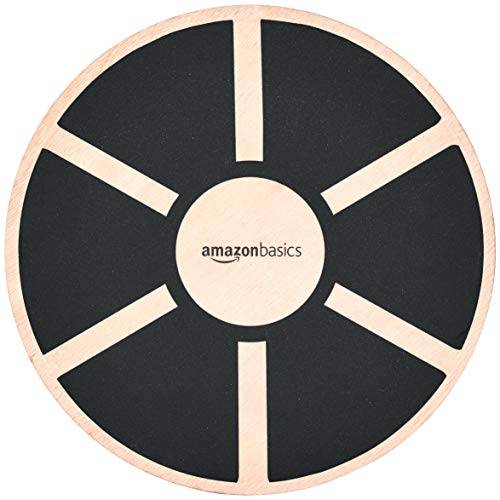
Seven balance boards ranked on footprint, capacity and honest trade-offs, with a clear winner for tight rooms and a runner-up for anyone chasing a bigger challenge.

By Alicia RoseUpdated 15 min read
On this page
- How I cut seven boards down to a ranking
- Does 'small spaces' actually hold up here?
- Best budget balance board for small spaces at a glance
- 1. Amazon Basics Wood Wobble Balance Trainer Board — Best overall
- 2. WANYIDA Ankle Foot Strengthener Exerciser — Best budget pick
- 3. Cesilili Wooden Balance Board — Best for heavy use
- 4. VEVOR Balance Board — Most versatile
- 5. Giongma Professional Wooden 360° Rotating Balance Board — Best upgrade
- 6. Flycoop Balance Board for Adult with Adjustable Stoppers — Best for families
- 7. Sportneer Balance Board — Best premium
- How much floor does each board really need?
- What separates a wobble board from a rocker?
- Which board wins at your weight?
- The verdict
- FAQ
The best budget balance board for small spaces is the Amazon Basics Wood Wobble Balance Trainer Board, a 15.75 x 15.75 in wood disc that holds a stated 265 lb and stores flat against a wall. If you need the tiniest footprint of all, the WANYIDA ankle trainer measures just 11.61 x 4.33 in and weighs 0.75 lb. Most guides fixate on weight capacity. In a small room the number that actually decides it is the board's on-floor footprint, because a 31.5 in roller board wins nothing if it won't fit your corner.
How I cut seven boards down to a ranking
I lined up the published specifications for all seven boards side by side and ranked them on the two things a tight-space buyer can verify before clicking buy: footprint and stated capacity. Three boards got cut from serious contention for the top spot on the same reasons.
First, the disqualifications:
- The Sportneer measures 31.5 x 14.17 in and weighs 10.6 lb. That's a garage board, not a bedroom board.
- The Flycoop weighs 11.5 lb, the heaviest here, which fights the "grab and stash" goal.
- The Cesilili publishes no dimensions at all, so I can't promise it fits anywhere.
What survived that screen was a small group of compact wood discs. The best budget balance board for small spaces had to clear a simple bar: fit a corner, store flat, and state a capacity you can trust your weight to. The Amazon Basics board did all three at the second-cheapest wood-disc price here. Everything below is ranked against that standard, and every pick keeps a real weakness on the table.
Does 'small spaces' actually hold up here?
Amazon's search treated "small spaces" loosely, so read this as a shopping consideration rather than a promise. Only some of these boards are genuinely compact, and you have to check the footprint yourself.
Here's the honest picture. The Amazon Basics disc is 15.75 in square. The Giongma is 17.5 x 13.4 in. The WANYIDA is a slim 11.61 x 4.33 in. Those three are apartment-friendly. The VEVOR runs 28 in long, the Sportneer 31.5 in, and the Flycoop ships "with stand," which needs its own parking spot.
So "small spaces" is real for three of the seven and a stretch for the rest. No board here folds or collapses, so storage means leaning it against a wall or sliding it under furniture. A light disc like the 3.44 lb Amazon Basics does that easily. A 10.6 lb roller set does not. Match the board to the wall you actually have, not the room you wish you had.
Best budget balance board for small spaces at a glance
| Pick | Footprint | Stated capacity | Price |
|---|---|---|---|
Best overall Amazon Basics Wood Wobble Balance Trainer Board |
15.75 x 15.75 in | 265 lb | Check Price |
Best budget pick WANYIDA Ankle Foot Strengthener |
11.61 x 4.33 in | Not listed | Check Price |
Best for heavy use Cesilili Wooden Balance Board |
Not listed | 350 lb claim | Check Price |
Most versatile VEVOR Balance Board |
28 in long | 441 lb claim | Check Price |
Best upgrade Giongma 360° Rotating Balance Board |
17.5 x 13.4 in | 500 lb claim | Check Price |
Best for families Flycoop Balance Board with Stoppers |
With stand | 200 kg claim | Check Price |
Best premium Sportneer 7-Mode Wobble Board |
31.5 x 14.17 in | 450 lb claim | Check Price |


1. Amazon Basics Wood Wobble Balance Trainer Board — Best overall
A 15.75 in square wood disc that holds 265 lb and tucks flat against a wall makes it the best budget balance board for small spaces.
Best for: a tight room where the board doubles as a plank platform Skip it if: you want a rocker with a moving roller
What sets this board apart in this group is the balance of size and honesty. It's 15.75 x 15.75 x 3.15 in and weighs 3.44 lb. That's compact enough to slide under a couch and light enough to carry one-handed. Amazon Basics says the solid wood top supports up to 265 pounds and lists a non-slip surface. The square shape matters more than it looks: it gives you a stable base for push-ups and planks, not just standing wobble work.
The listed exercises cover push-ups, planks and standing balance poses. Amazon Basics also backs it with a stated 1-year limited warranty, which most rivals here don't publish. It's the second-cheapest disc in the set and sells faster than any other board here.
The trade-off is capacity. At 265 lb, the stated ceiling is the lowest of the boards that publish one, so heavier users should look at the Cesilili instead. There's no roller and no adjustable difficulty either.
Pros:
- Compact 15.75 in square footprint
- Light 3.44 lb body carries one-handed
- Stated 1-year limited warranty, rare here
- Square top suits planks and push-ups
- The fastest-selling board in this set
Cons:
- Lowest stated capacity at 265 lb
- No roller or adjustable height
- Single seller lists it
2. WANYIDA Ankle Foot Strengthener Exerciser — Best budget pick
At 11.61 x 4.33 in and 0.75 lb, this is the smallest, cheapest board here, built for single-leg and ankle work.

Best for: ankle rehab and single-leg work in almost no floor space Skip it if: you want to stand on it with both feet
This is the cheapest of the seven and the most specialised. It measures 11.61 x 4.33 in and weighs just 0.75 lb, so it disappears into a drawer. WANYIDA describes it as an ankle and foot trainer made of birch plywood with a non-slip coating, aimed at sprain recovery and plantar fasciitis relief rather than full standing balance.
That focus is its strength and its limit. The narrow platform is sized for one foot, so it's ideal for rehab, ankle strengthening and posture work. WANYIDA lists it as FSA/HSA eligible, which can matter if you're buying for recovery. It's the smallest thing here by a wide margin.
The catch is that it doesn't do what most people picture when they say balance board. You can't do a two-footed wobble or plank on a 4.33 in wide strip. There's no published capacity figure either, so I can't tell you a weight ceiling.
Pros:
- Smallest footprint at 11.61 x 4.33 in
- Lightest board here, 0.75 lb
- The cheapest pick in this set
- Listed as FSA/HSA eligible
- Birch plywood with non-slip coating
Cons:
- Single-foot platform, not two-footed
- No published weight capacity
- Narrow use case, mostly rehab
3. Cesilili Wooden Balance Board — Best for heavy use
A yellow wood board with a stated 350 lb capacity at a near-cheapest price, held back only by missing dimensions.

Best for: heavier users who want the highest stated capacity for the price Skip it if: you need published dimensions before you buy
The draw here is capacity for money. Cesilili claims a 350 lb ceiling, higher than the Amazon Basics 265 lb, and it's the second-cheapest board in the set. For a heavier user on a budget, that combination is genuinely useful. Cesilili describes an anti-slip surface and a non-slip base with pads to protect the floor, plus ready-to-use assembly out of the box.
The listing leans on standing-desk and posture use, calling it good for easing back fatigue during office work. It also mentions gentle stability training for seniors and beginners. As a general home wobble board, that positioning fits.
Here's the problem. Cesilili publishes no size, no weight and no warranty. For a guide built around fitting small spaces, that's a real gap: I can't promise it clears your corner. The color is fixed at yellow, too, which won't suit every room. Buy it for capacity, and check the listing photos for size before you commit.
Pros:
- Stated 350 lb capacity beats the winner
- Second-cheapest board in the set
- Anti-slip surface and padded base claimed
- No assembly, ready out of the box
Cons:
- No published dimensions or weight
- No stated warranty
- Only yellow, single seller
4. VEVOR Balance Board — Most versatile
Three adjustable height levels and a claimed 441 lb capacity make this the board that grows with you, if you have 28 in of floor.

Best for: someone who wants three difficulty levels in one board Skip it if: your storage nook is under 28 in long
The VEVOR is the one board here built to get harder as you improve. VEVOR says the base adjusts across three heights, 2.5 in, 2.7 in and 2.9 in, with 360-degree rotation. That's a real advantage over the fixed discs: a beginner starts low, then raises the challenge without buying a second board. It's made from multi-layer solid wood with a claimed 441 lb capacity, the second-highest here.
At 4.19 lb it's still light enough to move and store easily, and it sits at a mid price for the set. VEVOR positions it for surf and paddle-board practice as well as everyday core work.
The cost is length. At 28 in, it's nearly double the width of the Amazon Basics disc, so "compact" is relative. If your storage spot is a narrow gap, measure first. Only one seller lists it, and the adjustable base means a little setup between levels rather than pure grab-and-go.
Pros:
- Three adjustable height levels claimed
- 360-degree rotation for varied work
- High stated 441 lb capacity
- Light 4.19 lb body for its size
Cons:
- 28 in long, not truly compact
- Setup needed to change levels
- Single seller stocks it
5. Giongma Professional Wooden 360° Rotating Balance Board — Best upgrade
A 17.5 x 13.4 in board with a claimed 500 lb capacity and a silicone-padded top, aimed at rehab and rotation training.

Best for: physical therapy and 360-degree rotation training Skip it if: you want a light board to move room to room
The Giongma reads as the therapy-minded upgrade in this group. It measures 17.5 x 13.4 x 3.5 in, so it stays reasonably compact, and Giongma claims a 500 lb capacity, the highest stated figure of any board here. The standout feature is the top surface: Giongma describes a high-grade gray mesh silicone pad for elasticity and a comfortable feel, which is softer underfoot than a bare wood disc.
The listing centers on rehabilitation, naming ankle and toe injuries, fractures, sprains and hamstring recovery. It uses a 360-degree half-ball base for full rotation. That makes it a strong pick for someone rehabbing an injury who also wants room to progress.
The trade-offs are two. No weight is published, so I can't tell you how heavy it is to move, and the premium price sits above three cheaper wood discs that cover the same basic wobble work. The silicone pad and rotation are the reasons to pay more, and only two sellers list it.
Pros:
- Highest stated capacity, 500 lb claim
- Silicone-padded top for comfort
- Compact 17.5 x 13.4 in footprint
- 360-degree rotation base
Cons:
- No published weight
- Premium price over cheaper discs
- Only two sellers list it
6. Flycoop Balance Board for Adult with Adjustable Stoppers — Best for families
Adjustable stoppers and three training modes let one board suit several skill levels, at the cost of being the heaviest here.

Best for: a household that shares one board across skill levels Skip it if: you want the lightest option on the shelf
The Flycoop earns its family label through adjustability. Flycoop says the back has holes and magnetic brackets for varied balance settings, and describes three modes plus adjustable stoppers, so a nervous beginner and a confident teen can use the same board at different difficulties. It ships "with stand" and Flycoop claims 15 layers of pressed wood supporting up to 200 kg.
Side holes double as handles for push-ups or as anchor points for resistance bands, which Flycoop notes are sold separately. That flexibility is the appeal for a shared home gym where one board has to please several people.
There are real costs. At 11.5 lb it's the heaviest board in the set, so it isn't a casual grab-and-stash disc, and the included stand needs its own floor space. It's also the most expensive tier here alongside the Sportneer, and it sells the slowest of the seven. Buy it for versatility across users, not for a compact corner.
Pros:
- Three modes with adjustable stoppers
- Magnetic brackets for varied settings
- Side holes for push-ups or bands
- 200 kg capacity claimed, 15-layer wood
Cons:
- Heaviest board here at 11.5 lb
- Stand needs its own space
- Premium price, slowest seller in the set
7. Sportneer Balance Board — Best premium
A 2-in-1 roller-and-ball set for dynamic training, best suited to a room with real space to spare.
Best for: a garage or spare room with space for a roller board Skip it if: your workout corner is genuinely small
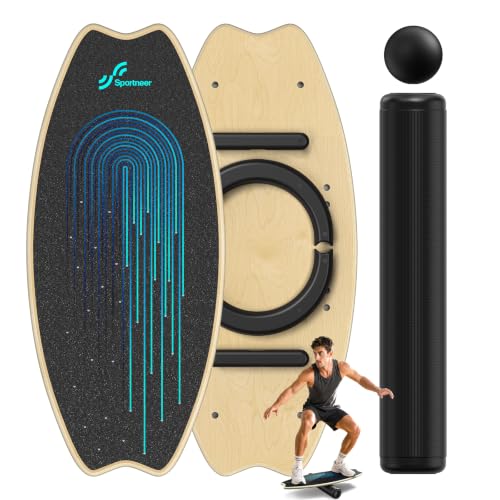
The Sportneer is the most capable and the least small. It's a 2-in-1 set with a roller and ball, measuring 31.5 x 14.17 in and weighing 10.6 lb. Sportneer says it's built from high-quality birch and holds up to 450 pounds, with a matte non-skid surface. The roller adds a moving element that fixed discs can't match, letting you build the kind of side-to-side control surfers and skaters train for.
Three sellers list it, more than any other board here, and the set includes three pieces. Sportneer positions it as a companion to weight training and aerobics for people who already work out seriously.
The reason it lands last in a small-space guide is right there in the numbers. At 31.5 in long and 10.6 lb, it's the biggest, heaviest board in the set, and the roller needs floor room to actually roll. It's also the most expensive pick. For a bedroom or a shared living space, it's the wrong tool, however good the board itself is.
Pros:
- 2-in-1 roller and ball set
- High stated 450 lb capacity
- Birch build with matte non-skid top
- Three sellers stock it
Cons:
- Largest footprint at 31.5 in
- Heaviest disc-plus-roller here, 10.6 lb
- Most expensive pick in the set
How much floor does each board really need?
In a small room, the footprint number decides everything, and the boards split into three clear groups. Here they are, smallest to largest:
- WANYIDA, 11.61 x 4.33 in, a single-foot strip.
- Amazon Basics, 15.75 x 15.75 in, a compact square disc.
- Giongma, 17.5 x 13.4 in, still apartment-sized.
- VEVOR, 28 in long, the start of the big group.
- Sportneer, 31.5 x 14.17 in, plus a rolling roller.
- Flycoop, ships with a stand that needs parking.
- Cesilili, no published size, so you're guessing.
The lesson is simple. A roller board needs not just its own length but clearance to move on, so budget more than the printed dimension. A fixed disc only needs the space it stands on. If your workout corner is a yoga-mat width of floor, the top three on that list are your realistic shortlist, and the Amazon Basics square is the most useful of them.
What separates a wobble board from a rocker?
These boards aren't all the same tool, and buying the wrong type is the fastest way to be disappointed. A quick glossary:
- A wobble board is a disc on a rounded base that tilts in every direction. The Amazon Basics, Cesilili and Giongma work this way.
- A rocker board rocks along one axis, front to back or side to side, and is often longer.
- A roller board sits on a separate roller, so the whole board slides sideways. The Sportneer is this kind.
- An adjustable board changes difficulty. The VEVOR offers three heights; the Flycoop uses stoppers and modes.
The 360-degree rotation on the Giongma and VEVOR is a wobble-plus feature: it spins as well as tilts. A roller is the hardest to master and needs the most space. For a beginner in a small room, a fixed wobble disc is the safest, most storable start.
Which board wins at your weight?
Stated capacity is the second number I'd check, and the boards vary widely. Here's how the published claims stack up, and the honest caveats:
- Amazon Basics: 265 lb, the lowest stated figure but with a warranty behind it.
- Cesilili: 350 lb claim, no dimensions published.
- Sportneer: 450 lb claim, birch construction.
- VEVOR: 441 lb claim, adjustable base.
- Giongma: 500 lb claim, the highest here.
- WANYIDA and Flycoop: WANYIDA lists none; Flycoop claims 200 kg.
Treat every figure except the Amazon Basics number as a manufacturer claim, not a measured limit, and give yourself margin. If you're near the top of any board's range, the Giongma, Sportneer and VEVOR claims give the most headroom. Lighter users lose nothing by taking the compact Amazon Basics 265 lb board, which is why it wins the small-space case.
The verdict
If your space is tight and your budget is modest, the Amazon Basics Wood Wobble Balance Trainer Board is the best budget balance board for small spaces. It's a 15.75 in square, 3.44 lb, holds a stated 265 lb, and carries a 1-year limited warranty that almost nobody else here publishes. It stores flat, doubles as a plank platform, and it's the fastest-selling board in the group. That's the safe default for most people.
If you weigh near the top of that 265 lb ceiling, switch to the Cesilili, which claims 350 lb at a near-identical price. Its exact advantage is headroom: a higher stated capacity for heavier users who can live without published dimensions. And if your goal is rehab in almost no space, the WANYIDA foot trainer is the cheapest pick and the smallest, at 11.61 x 4.33 in.
The cutoff is your floor. Under a yoga-mat width, stick to the compact discs. With a spare room and a taste for progression, the VEVOR's three heights or the Sportneer's roller reward the extra space. For everyone else, start with the winner.
FAQ
Is a budget balance board worth it over a premium one?
A budget balance board is worth it for most beginners and small-space users. The Amazon Basics disc covers core, posture and standing balance work for a fraction of the roller sets, and stores flatter. You pay more for a roller like the Sportneer or adjustable heights on the VEVOR, features you only need once you've outgrown a fixed disc.
Is a balance board worth it for a small apartment?
A balance board is worth it in a small apartment only if you pick a compact one. The Amazon Basics square is 15.75 in and 3.44 lb, so it slides under furniture. The WANYIDA is smaller still at 11.61 x 4.33 in. Avoid the 31.5 in Sportneer and the stand-equipped Flycoop, which need real floor and can't tuck away.
What weight capacity do these balance boards support?
The weight capacity these balance boards support ranges widely by claim. Amazon Basics states 265 lb with a warranty behind it. Cesilili claims 350 lb, VEVOR 441 lb, Sportneer 450 lb, and Giongma the highest at 500 lb. Treat every figure except the Amazon Basics number as a manufacturer claim and leave yourself margin near the top of any range.
Amazon Basics or Cesilili for a heavier user?
For a heavier user, Cesilili wins on the number and Amazon Basics wins on trust. Cesilili claims 350 lb versus the Amazon Basics 265 lb, at a near-identical price. But Cesilili publishes no dimensions or warranty, while Amazon Basics lists a 15.75 in size and a 1-year limited warranty. Choose Cesilili for capacity, Amazon Basics for a verified fit.
What is the biggest mistake buying a balance board?
The biggest mistake buying a balance board is choosing on capacity alone and ignoring footprint. A 500 lb rating means nothing if the 31.5 in board won't fit your corner. Measure your storage spot first, then match a board to it. A compact wobble disc suits tight rooms; save the roller boards for a garage or spare room.
Measure the gap where you'll store the board, then decide. If it's tight, the Amazon Basics square wins outright: it's compact, light, honestly specified, and backed by a warranty the pricier boards skip. Balance training only helps if you actually do it, and the board that lives within arm's reach of your workout spot is the one you'll step onto every day. Start there, add a roller board later if you outgrow it, and you'll have spent the least to build the most useful habit.