Best Heavy Duty Air Compressor for Truck Tires

A 3.2 lb cordless inflator and a 105-gallon rotary screw compressor both call themselves heavy duty. Here's which one belongs in your bay, and which one belongs in your truck.

By Alicia RoseUpdated 17 min read
On this page
- Best heavy duty air compressor for mechanics at a glance
- Why picks got cut, and what survived
- Inflator or shop compressor: which do you need?
- 1. OlarHike 12000mAh Heavy Duty Tire Inflator — Best overall
- 2. DEWALT Tire Inflator Portable Air Compressor 20V MAX — Best upgrade
- 3. VEVOR 10.6 CFM Heavy Duty Air Compressor — Best for pros
- 4. MechMaxx 20HP Combined Rotary Screw Air Compressor with Dryer — Best premium
- 5. ECOMAX Air Compressor 6 Gallon 150 PSI Pancake — Best minimal setup
- 6. GSPSCN 12V Heavy Duty Tire Inflator — Best budget pick
- What does heavy duty actually mean here?
- How much air do impact tools really pull?
- What the listings leave out
- The verdict
- FAQ
The best heavy duty air compressor for mechanics is the OlarHike 12000mAh Heavy Duty Tire Inflator, because at 3.2 lb it puts twin-cylinder inflation wherever the car is without needing a cord. The DEWALT DCC020IB is the better buy if you already own 20V MAX batteries, since it runs off those, 12V DC, or 110V AC and carries a 3-year warranty. Get the choice wrong and you find out at the worst moment. A pocket inflator will not spin an impact wrench, and a 105-gallon tank will not fit in a truck bed.
Best heavy duty air compressor for mechanics at a glance
| Pick | Air source | Weight | Price |
|---|---|---|---|
Best overall OlarHike 12000mAh Heavy Duty Tire Inflator |
Built-in battery or 12V car |
3.2 lb | Check Price |
Best upgrade DEWALT Tire Inflator 20V MAX |
20V MAX, 12V DC or 110V AC |
6.39 lb | Check Price |
Best for pros VEVOR 10.6 CFM Heavy Duty Air Compressor |
12V, 6.5 ft cord | 25.4 lb | Check Price |
Best premium MechMaxx 20HP Rotary Screw with Dryer |
230V 3-phase | 105-gal tank | Check Price |
Best minimal setup ECOMAX 6 Gallon 150 PSI Pancake |
Household AC | 34.17 lb claim | Check Price |
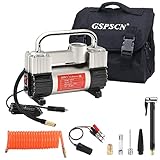
Best budget pick GSPSCN 12V Heavy Duty Tire Inflator |
12V, 11.5 ft cord | 6 lb | Check Price |


Why picks got cut, and what survived
Three things knocked listings out of this comparison, and knowing them tells you how to read the six that stayed.
- No published pressure or airflow figure. A compressor that won't state a PSI ceiling or a CFM number gives you nothing to plan around. Every survivor here publishes at least one.
- A single power source with no fallback. A 12V-only unit is fine in a trunk and useless in a bay with no vehicle in it. The two inflators that scored highest offer more than one way to feed them.
- A tank with no accessory path. A bare tank and pump is half a purchase. The ECOMAX ships a 25 ft PVC hose and a 10-piece kit; the VEVOR ships a 26 ft rubber hose and three nozzle adapters.
What survived splits cleanly into two families. Four are 12V or battery tire inflators in the 3.2 lb to 25.4 lb range. Two are actual compressors with tanks, one at 6 gallons on household power and one at 105 gallons on 230V three-phase. That gap is the whole story of this category.
Note the search behind this guide. "For mechanics" is a job description, not a specification, and nothing in these listings certifies a product as shop-grade. Judge that yourself against the numbers below.
Inflator or shop compressor: which do you need?
This is the fork, and most guides blur it. A tire inflator is a pump. A shop compressor is a pump plus a tank, and the tank is what lets you pull more air out than the motor makes in that second.
If your work is tires, pressure checks, seating a bead and topping off a spare, an inflator is the right tool and the smaller ones are genuinely better because you'll actually carry them. The OlarHike at 3.2 lb and 2.5 x 7.3 x 3.8 in fits a door pocket. The GSPSCN at 6 lb still fits a trunk organizer.
If your work involves an impact wrench, a die grinder, a cut-off tool or a spray gun, you need a tank, and the size of that tank sets how long you can work before the motor catches up. Here's the trick with tanks: the 6-gallon ECOMAX is a reservoir for short bursts, while the 105-gallon MechMaxx with 78 CFM is a genuine air supply.
Buying an inflator when you needed a compressor is the most common expensive mistake in this category. The listing says heavy duty either way.
1. OlarHike 12000mAh Heavy Duty Tire Inflator — Best overall
The lightest pick here by a wide margin, and the only one that runs with nothing plugged in at all.
Best for: roadside and driveway tire work with no outlet nearby Skip it if: you need to run air tools
At 3.2 lb, this weighs less than a fifth of the VEVOR and about half of the DEWALT. Its 2.5 x 7.3 x 3.8 in footprint is the smallest in the set, and that's the argument for it. A pump you keep in the vehicle gets used; a pump on a shelf doesn't. OlarHike says the twin-cylinder engine takes a 195/65R15 sedan tire from 30 to 35 PSI in 20 seconds, and that the 12000mAh pack can be bypassed entirely by running off the 12V car adapter for longer sessions. That dual arrangement is genuinely useful: battery for a quick check in a parking lot, 12V when you're doing all four corners.
The listing also claims a battery management system covering over-charge, over-discharge, 19A over-current, short-circuit and temperature, plus a patented twist-lock hose fitting, auto-stop and an LED. The kit is two hoses, a lock-on air chuck, adapters, and both the 12V DC cable and a USB charging cable.
The trade-off against the rest of this set is honest and simple. This is a tire tool. It publishes no CFM figure, no tank, and no warranty term, while the DEWALT states 3 years and the GSPSCN states 1 year.
Pros:
- Lightest pick in the set at 3.2 lb
- Smallest footprint here, 2.5 x 7.3 x 3.8 in
- Runs cordless or on continuous 12V power
- Two hoses, chuck and adapters included
- Twist-lock fitting and auto-stop claimed
Cons:
- No published CFM or airflow figure
- No stated warranty, unlike two rivals here
- No tank, so no air-tool use at all
- Only two sellers list it
2. DEWALT Tire Inflator Portable Air Compressor 20V MAX — Best upgrade
Three power sources and a stated 3-year warranty make this the safest inflator bet in the group.

Best for: anyone already on the 20V MAX battery platform Skip it if: you own no compatible batteries
The DCC020IB is the flexibility pick. DEWALT lists three inputs: a 20V MAX battery, 12V DC, or 110V AC. No other product here offers all three, and that matters if you split time between a bay with outlets and a driveway with none. It weighs 6.39 lb and measures 2.2 x 10.5 x 7.7 in, so it's roughly double the OlarHike's mass and noticeably longer.
The 3-year limited warranty on material and workmanship is the longest published term in this set, against 1 year from GSPSCN and nothing stated from the other four. That alone reframes the value. DEWALT also lists a high-pressure mode with automatic shutoff, separate high-volume inflate and deflate modes for larger items, a threaded chuck, onboard accessory storage, heavy-duty rubber feet to limit walking, and an LED.
The catch is right there in the title: tool only. No battery, no charger. If you're not already on the platform, the practical cost of getting this running is higher than its position here suggests, and the 12V or AC cords become your default. Only one seller lists it, and like the OlarHike it publishes no CFM number, so you can't size it against the VEVOR's 10.6 CFM claim.
Pros:
- Runs on 20V MAX, 12V DC or 110V AC
- Longest published warranty here at 3 years
- Deflation mode as well as two inflation modes
- Threaded chuck and onboard accessory storage
Cons:
- Sold tool only, no battery or charger
- Heavier than the OlarHike at 6.39 lb
- No published airflow or CFM rating
- Single seller on the listing
3. VEVOR 10.6 CFM Heavy Duty Air Compressor — Best for pros
The only inflator here that publishes a CFM figure, and the one built for commercial truck tire volume.

Best for: commercial truck and RV tires at 150 PSI Skip it if: you want something you can carry one-handed
VEVOR publishes 10.6 CFM and 150 PSI, and that pairing is why this earns the pro label among the 12V units. Large tires are a volume problem, not a pressure problem, and 10.6 CFM is a number you can actually plan against. Neither the OlarHike nor the DEWALT gives you one. VEVOR claims 30-second inflation from upgraded dual cylinders and lists auto-thermal cut-off to protect the motor under sustained load, which is the failure mode that kills cheap inflators on the third tire.
The kit is the most generous in the set for reach: a 26 ft rubber air hose with a mechanical pressure gauge, a 6.5 ft power cord, three nozzle adapters and a thumb-lock adapter. On an RV or a dually, that hose length is the difference between moving the unit twice and not moving it at all.
Then the weight. 25.4 lb, in a 14.4 x 8.94 x 5.91 in body, makes this roughly eight times the OlarHike and four times the DEWALT. This is a two-hands, set-it-on-the-ground tool that lives in a truck box. There's no published warranty term either, which stings more on the heavier, pricier unit than it does on the budget pick.
Pros:
- Publishes 10.6 CFM, the only inflator here that does
- 150 PSI ceiling suits truck and RV tires
- 26 ft rubber hose, longest in the set
- Auto-thermal cut-off claimed for sustained runs
Cons:
- 25.4 lb, by far the heaviest inflator here
- Short 6.5 ft power cord relative to its bulk
- No published warranty term
- Still tankless, so no air-tool duty
4. MechMaxx 20HP Combined Rotary Screw Air Compressor with Dryer — Best premium
A 78 CFM, 105-gallon industrial unit that answers a completely different question than the other five.

Best for: a shop with 230V three-phase service and floor space Skip it if: you have single-phase power
This is the only pick that supplies real shop air. The ML2023 pairs a 20HP rotary screw with an integrated dryer and a 105-gallon ASME tank, rated at 78 CFM and 116 PSI on 230V three-phase. Compare that 78 CFM to the VEVOR's 10.6 CFM and the scale gap is obvious. Rotary screw units are built for continuous duty rather than the intermittent cycling a piston pump expects, which is why they turn up in production shops.
MechMaxx describes an IP54 motor with fully enclosed dust-proof F-class insulation and SKF heavy-duty bearings, an airend held to micron tolerances, an oil-gas separation system with a dedicated separation element and oil return, and an EPC control system with automatic load/unload regulation and fault diagnostics. The built-in dryer matters if you spray paint or run precision air tools, because water in the line ruins both.
Two hard constraints decide this one for you, and neither is negotiable. 230V three-phase power is not present in most residential garages or small independent bays. And a 105-gallon horizontal tank plus dryer needs dedicated floor space and a plumbed drop. It's also the most expensive pick here, the slowest seller of the six, with a single seller and by far the thinnest published specification list of the group.
Pros:
- 78 CFM covers multiple air tools at once
- 105-gallon ASME tank and 116 PSI rating
- Integrated dryer for cleaner air downstream
- Rotary screw design suits continuous duty
Cons:
- Requires 230V 3-phase, ruling out most home shops
- Most expensive pick in the set by a wide margin
- Sparse published specs: no weight or dimensions listed
- Needs dedicated floor space and hard plumbing
5. ECOMAX Air Compressor 6 Gallon 150 PSI Pancake — Best minimal setup
The cheapest route to a tank and an air-tool coupler on ordinary household power.

Best for: a home bay running a blow gun and small ratchet Skip it if: you need sustained air for an impact wrench
This is the bridge between the inflators and the industrial unit. A 6-gallon tank at 150 PSI, driven by a 1.5HP oil-free pump on a normal outlet, gives you the reservoir the four 12V units lack. ECOMAX lists dual gauges, dual quick couplers so two lines can run at once, and a winding bracket for the cord. The accessory kit is the fullest here: a 1/4 in x 25 ft PVC air hose, thread seal tape, a ball-foot air chuck and NPT plugs among 10 pieces.
The body measures 19.5 x 16.5 x 15.9 in, and ECOMAX puts the weight at 34.17 pounds with a flip-up handle. It also claims low-voltage and cold-weather start capability, which is worth something in an unheated garage in January.
The honest limit is duty cycle. Six gallons at 150 PSI empties fast under a half-inch impact wrench, and then you wait on an oil-free 1.5HP pump. It suits blow guns, tire chucks, brad nailers and short ratchet bursts. Oil-free pumps also tend to be the loudest members of a compressor family, and no noise figure is published here. The listing gives no weight in the specifications and no warranty term, and it sits in the upper price group despite being the smaller of the two tanked picks.
Pros:
- 6-gallon tank at 150 PSI on household power
- Dual quick couplers for two lines at once
- 10-piece kit with 25 ft hose included
- Cold-weather and low-voltage start claimed
Cons:
- Small tank drains quickly under an impact wrench
- Oil-free pump with no published noise figure
- No warranty term and no weight in the specs
- Priced in the upper group for a 6-gallon unit
6. GSPSCN 12V Heavy Duty Tire Inflator — Best budget pick
The cheapest pick here, with the longest power cord and a published noise claim nobody else offers.

Best for: keeping one in the trunk of every vehicle you own Skip it if: you inflate more than a couple of tires at a time
At 6 lb in a metal body measuring 3.1 x 8.7 x 7 in, this is the cheapest of the six and the only one besides the DEWALT with a stated warranty, at 1 year. GSPSCN lists 150 PSI maximum and 70 L/min airflow from a direct-drive double-cylinder pump, and claims a 200/70/R18 tire goes from 0 to 35 PSI in about a minute. The direct-drive layout runs at lower rotating speed, which the brand ties to efficiency.
Two practical details separate it from the other budget-adjacent options. The 11.5 ft power cord plus 11.5 ft air hose gives roughly 23 ft of combined working reach, so one clip to the battery covers all four tires on most cars. And GSPSCN puts the noise at 70dB against a claimed 90dB for typical rivals. That's a manufacturer comparison rather than a standardised measurement, but it's the only decibel figure published anywhere in this set.
Where it gives ground is sustained work. Its 70 L/min converts to well under the VEVOR's claimed 10.6 CFM, so large or heavily deflated tires take real time, and no thermal cut-off is mentioned. There's no cordless option either, so a dead vehicle battery means no air.
Pros:
- Cheapest of the six picks
- Roughly 23 ft combined cord and hose reach
- 1-year manufacturer warranty stated
- Only pick publishing a decibel figure, 70dB
Cons:
- 70 L/min is modest for large truck tires
- No thermal cut-off protection mentioned
- 12V only, with no battery or AC fallback
- Noise claim is the brand's own comparison
What does heavy duty actually mean here?
Every one of these six listings uses the phrase, and it means four different things across the set. Worth knowing which one you're being sold.
- Twin cylinders. OlarHike, VEVOR and GSPSCN all cite dual-cylinder pumps. Two cylinders move more air per revolution than one, so this is the most substantive use of the term among the inflators.
- Metal construction. GSPSCN leads with a metal body. Housing material has nothing to do with airflow, but it does affect heat shedding and survival in a toolbox.
- Thermal protection. VEVOR names auto-thermal cut-off; OlarHike names a full battery management system. Both address the same reality, which is that a small pump under sustained load gets hot.
- Genuine industrial rating. Only the MechMaxx qualifies on duty cycle, with a rotary screw airend, an ASME tank and 78 CFM.
The word to look for on any tire inflator is the airflow figure, in CFM or L/min. VEVOR gives 10.6 CFM. GSPSCN gives 70 L/min. OlarHike and DEWALT give neither, which is why their inflation claims are tied to one specific tire size instead. That's not disqualifying, but it means you're trusting a scenario rather than a rate.
How much air do impact tools really pull?
This is where buyers of a heavy duty air compressor for mechanics get burned, so here are the shapes of the problem rather than a spec sheet.
A half-inch impact wrench is a continuous-draw tool. It doesn't sip air in bursts the way a brad nailer does; it pulls steadily for as long as the trigger is down. A ratchet is gentler. A die grinder and a cut-off wheel are worse than the impact, and a spray gun is the most demanding of all because it needs both volume and dry air.
Rank your tools by draw before you buy:
- Blow gun, tire chuck, brad nailer. Short bursts. A 6-gallon tank handles these.
- Air ratchet, small impact. Intermittent draw. A 6-gallon tank works with pauses.
- Half-inch impact, die grinder, cut-off tool. Continuous. You want a large tank and real CFM.
- Spray gun and blast cabinet. Continuous plus dry air. This is where the MechMaxx dryer earns its place.
Match the tool to the tier and the pick chooses itself. Groups 1 and 2 point at the ECOMAX. Groups 3 and 4 point at the MechMaxx, assuming you have the power for it. Nothing else in this set drives air tools at all, because four of these six are tire inflators with no tank.
What the listings leave out
Reading these six listings side by side, the gaps are as informative as the specifications.
Duty cycle is absent everywhere except by implication. No inflator here states how many minutes it can run before it needs to cool. VEVOR's thermal cut-off and OlarHike's temperature protection tell you the limit exists; neither tells you where it is. If you're doing a full set of truck tires, expect pauses.
Noise is published once. GSPSCN cites 70dB. Nobody else gives a figure, including the oil-free pancake, and oil-free pumps are typically the loudest thing in a small garage.
Weight is missing where you'd want it most. The MechMaxx specifications list only a count and a model number. For a 105-gallon industrial unit, weight and footprint decide whether it can even go where you plan to put it, and you'll need to confirm that before ordering.
Warranty appears twice out of six. DEWALT states 3 years, GSPSCN states 1 year. The other four state nothing, which is not the same as having none, but it does mean you're buying without a published term.
CFM appears twice. VEVOR at 10.6 CFM, MechMaxx at 78 CFM. On the rest, sizing is guesswork.
The verdict
Read this by tier, because the price positions in this set map almost perfectly onto three different jobs.
At the entry end, the OlarHike and the GSPSCN are both tire tools and both good ones. The OlarHike wins the overall spot on portability: 3.2 lb and a 2.5 x 7.3 x 3.8 in body, cordless or 12V, with a 20-second claim on a 195/65R15. The GSPSCN is the cheaper pick with a 1-year warranty, a 70dB claim and about 23 ft of combined reach, and it's the one to buy in multiples for multiple vehicles.
In the middle sit the DEWALT and the VEVOR, and they split by tire size. The DEWALT's 3-year warranty and three power inputs make it the best all-round inflator if you own 20V MAX batteries. The VEVOR's 10.6 CFM, 150 PSI and 26 ft hose make it the pick for commercial truck and RV rubber, at the cost of 25.4 lb.
At the top, the tanks. The ECOMAX 6-gallon at 150 PSI is the minimum viable setup for a blow gun and a ratchet on a normal outlet. The MechMaxx at 78 CFM with a 105-gallon ASME tank and dryer is the only real shop supply here, and it needs 230V three-phase. The cutoff is your electrical panel.
FAQ
Is a heavy duty air compressor for mechanics worth it over a cheap inflator?
A heavy duty air compressor for mechanics is worth it when your work outgrows topping off tires. The VEVOR's published 10.6 CFM and the MechMaxx's 78 CFM buy you speed on large tires and the ability to run air tools respectively. If you only check pressures and inflate a spare, the 6 lb GSPSCN at 150 PSI does that job for the least money.
What size tank do I need to run an impact wrench?
Tank size determines how long you can pull the trigger before the pump catches up. The ECOMAX 6-gallon at 150 PSI handles short bursts from a ratchet or small impact with pauses between. A half-inch impact under continuous load wants far more, which is the case for something like the MechMaxx 105-gallon ASME tank at 78 CFM.
DEWALT DCC020IB or OlarHike: which inflator should I pick?
Picking between the DEWALT and the OlarHike comes down to weight and warranty. The OlarHike weighs 3.2 lb, half the DEWALT's 6.39 lb, and runs cordless off its own 12000mAh pack. The DEWALT accepts 20V MAX, 12V DC and 110V AC and carries a 3-year warranty, but it ships tool only, so you need a battery already.
Can I plug the MechMaxx rotary screw compressor into a normal outlet?
You cannot plug the MechMaxx into a normal outlet. It's specified at 230V three-phase, which most homes and many small independent shops do not have. Confirm your service before ordering, because retrofitting three-phase power is a licensed electrical job. If your panel is single-phase, the ECOMAX 6-gallon pancake runs on ordinary household current instead.
What is the most common mistake buying a heavy duty air compressor for mechanics?
The most common mistake buying a heavy duty air compressor for mechanics is confusing a tire inflator with a shop compressor. Four of the six picks here are tankless 12V or battery inflators. They move air into tires and nothing more. Only the ECOMAX and the MechMaxx have tanks, and a tank is what air tools require.
Start with the tool that draws the most air in your bay and size from there. If that tool is a tire chuck, buy the OlarHike, keep it in the door pocket, and stop thinking about it. Its 3.2 lb weight is the whole reason it wins here: the lightest capable pump is the one that's actually with you when a tire is soft in a parking lot at night, which is exactly when a 34 lb pancake in the garage helps nobody. If your heaviest tool is a half-inch impact, skip the inflators entirely and check your panel first.