Best Heavy Duty Adjustable Grip Strengthener by Range

Seven adjustable grippers, ranked by resistance range, handle comfort and honest top-end numbers. The FitBeast leads, but a wider ceiling changes the pick.

By Alicia RoseUpdated 16 min read
On this page
- What actually decides a heavy duty gripper?
- Best heavy duty adjustable grip strengthener at a glance
- How I ranked seven adjustable grippers
- Does a rep counter earn its place?
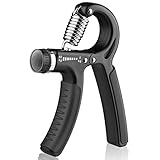
- 1. FitBeast Grip Strengthener Forearm Strengthener — Best overall
- 2. FitBeast Grip Strengthener Hand Grips Kit — Best upgrade
- 3. AIXPI Grip Strength Trainer — Best minimal setup
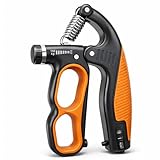
- 4. Hiyoga Grip Strength Trainer with Automatic Counter — Best for pros
- 5. KDG Grip Strength Trainer 2-Pack — Runner-up
- 6. CoreMuse Grip Strength Trainer — Best budget pick
- 7. GD PRO-70 Grip Strength Trainer — Best premium
- How high is the resistance ceiling, really?
- When a different pick wins
- The verdict
- FAQ
The best heavy duty adjustable grip strengthener is the FitBeast Grip Strengthener, which dials from 10 to 132 lbs on a single steel spring and covers rehab-light loads through serious forearm work. If you want the widest ceiling instead, the CoreMuse claims 22 to 330 lbs. The obvious move is to compare top-end numbers. That is the trap. The number printed on the frame and the load your hand actually meets are rarely the same, so range width matters less than an honest range.
What actually decides a heavy duty gripper?
Most guides to the best heavy duty adjustable grip strengthener line up the maximum resistance figures and crown the biggest one. That is the wrong first move. A printed ceiling is a claim, not a calibrated load.
GD makes exactly this point about its own category. Its listing warns that "the maximum resistance of many grippers on Amazon is more than 130lbs" yet they "feel like toys when you squeeze them." That is a competitor calling out inflated numbers, and it reframes the whole decision.
So what does decide it? Three things you can check:
- The span between minimum and maximum. A gripper that starts at 10 lbs lets you warm up and rehab; one that starts at 55 lbs does not.
- Handle size and coating. A wide, non-slip handle changes how much of that resistance your fingers can actually apply.
- Whether the top number is credible. A modest, honest ceiling beats a huge, soft one.
Grip resistance is the load your hand must overcome to close the handles. Range is the gap between the easiest and hardest settings. A rep counter is a mechanical dial that logs closes. None of those three replaces the others. Read the range as a working window, not a bragging figure, and the field sorts itself quickly.
Best heavy duty adjustable grip strengthener at a glance
| Pick | Resistance range | Count | Price |
|---|---|---|---|
Best overall FitBeast Grip Strengthener |
10–132 lbs | 1 | Check Price |
Best upgrade FitBeast 5-Pack Kit |
Adjustable (5 pieces) | 5 | Check Price |
Best minimal setup AIXPI Grip Strength Trainer |
11–132 lbs claim | 1 | Check Price |
Best for pros Hiyoga Grip Trainer + Counter |
5–100 kg claim | 1 | Check Price |
Runner-up KDG 2-Pack Trainer |
10–130 lbs claim | 2 | Check Price |
Best budget pick CoreMuse Grip Trainer |
22–330 lbs claim | 1 | Check Price |
Best premium GD PRO-70 Gripper |
55–154 lbs | 1 | Check Price |





How I ranked seven adjustable grippers
I lined up the published specifications side by side and cut on three named failures before I ranked anything.
First cut: no usable low end. A heavy duty gripper still has to serve warm-ups and light days. The GD PRO-70 starts at 55 lbs, which rules it out for anyone recovering from an injury, so it lands as a specialist premium pick rather than a default.
Second cut: a soft or unstated ceiling. Where a listing gives a huge top number with no way to judge it, I treated the number with suspicion rather than reward. That is why the 330 lb CoreMuse sits at budget rank and not the top.
Third cut: thin published detail. The Hiyoga lists only colour, weight and dimensions, with resistance given as a feature claim rather than a standardised spec. That is enough to place it, not enough to lead.
What survived, I weighted like this:
- Range honesty first: a credible span beats a large one.
- Handle and build detail second, from the specs and attributed claims.
- Count and configuration third: single, pair or kit.
- How briskly the pick moves in its category, as a tie-breaker only.
The FitBeast single unit wins on the first two. It states a full 10 to 132 lb span on one spring, and it moves faster than every premium pick here.
Does a rep counter earn its place?
Four of these seven build in a counter, so it is worth asking whether the feature matters or just adds a part that can jam. Here is the honest split.
A counter is a mechanical dial that logs each close and resets by twisting a button. Hiyoga describes exactly that, "easily reset by rotating the button." CoreMuse says its counter "tracks your reps automatically—no batteries needed." KDG adds the same counting function across its pair.
When the counter helps:
- You train to a rep target and don't want to count out loud.
- You log progress across weeks and want a number, not a guess.
- You do high-rep endurance sets where losing count is easy.
When it is dead weight:
- You train by feel or by time.
- You do low-rep, high-resistance singles where counting is trivial.
- You want the fewest moving parts on a tool you'll carry in a bag.
The FitBeast overall pick has no counter, and it still leads, because its range is the stronger asset. Treat the counter as a nice-to-have that suits loggers and climbers, not as the thing that decides your buy.
1. FitBeast Grip Strengthener Forearm Strengthener — Best overall
The FitBeast wins because it pairs an honest, wide 10 to 132 lb span with a single-spring design that suits both light rehab and heavy forearm work.
Best for: one hand that needs a full 10 to 132 lb span Skip it if: you want a matched pair for both hands
What sets this FitBeast apart in this set is the low end. It starts at 10 lbs, lower than the AIXPI's 11 lbs and far below the GD PRO-70's 55 lb floor, so you can warm up, rehab and progress on the same tool. The 132 lb ceiling is the highest credible top number here that isn't a triple-digit outlier. FitBeast calls the resistance "perfect for all fitness levels," and the span backs that up.
The unit weighs 5.64 oz and measures 0.04 x 6.2 x 4.5 in, so it drops into a gym bag without thought. FitBeast says the handles are "extended ergonomic" to cut strain, and describes a "robust steel spring" with a "textured, non-slip handle." Those are the maker's words, not a measured result, but the spec sheet supports a compact, single-piece build.
Its trade-off against the field is configuration. It's one gripper, not a pair or a kit, so two-hand trainers and progression buyers look elsewhere.
Pros:
- Full 10–132 lb span on one spring
- Lowest usable floor in the set
- Light 5.64 oz body, bag-friendly
- Moves briskly in its category
- Non-slip textured handle claim
Cons:
- Single unit only, no matched pair
- No rep counter for loggers
- Slim published materials detail
2. FitBeast Grip Strengthener Hand Grips Kit — Best upgrade
This five-piece FitBeast kit is the upgrade pick because it hands you a progression ladder instead of one dialable gripper.

Best for: training with a multi-piece progression kit Skip it if: you only need one dialable gripper
The differentiator here is the count. You get 5 pieces, the most in this set, and the whole kit weighs 0.82 lb across dimensions of 0.1 x 6.18 x 4.53 in. Where the single grippers ask you to dial resistance up and down, a kit lets you keep fixed steps ready and move up as you gain. FitBeast describes "adjustable resistance" so you "progress at your own pace," and a "contoured shape" that fits the palm.
This is also the only pick here with a stated warranty term of 1, which is a small but real edge over the single units that publish none. It moves faster in its category than any other pick in the set, so it's a well-worn choice.
The catch is that a kit is bulkier and less focused than one great gripper. If you want a single tool that spans the whole range on its own, the overall FitBeast does that in one hand. Buy the kit when you like a physical ladder of pieces over one adjustable dial.
Pros:
- Five pieces for a full progression
- Only pick with a stated warranty term
- Fastest-moving pick in the set
- Contoured, textured handle claim
Cons:
- Bulkier than a single gripper
- Resistance steps not given as figures
- Overkill if you only need one
3. AIXPI Grip Strength Trainer — Best minimal setup
The AIXPI is the clean single-gripper pick: soft-wrapped handles, a plain adjustable dial and nothing extra to break.

Best for: a plain single gripper with soft-wrapped handles Skip it if: you want the top of the resistance range
The AIXPI matches the overall FitBeast on weight, 5.64 oz, and runs slightly more compact at 0.04 x 5.83 x 4.33 in. What's worth flagging is the range wording. The product title claims 11 to 132 lbs, while its own feature text says "5kg-60kg (11-110 Lbs)." That internal gap is exactly the kind of soft ceiling this category is famous for, so treat the top end as the lower, stated 110 lb figure to be safe.
AIXPI says the handle is "wrapped in a soft material" for comfort and describes "heavy-duty plastic and reinforced metal alloy." Those are maker claims. The appeal here is simplicity: no counter, no kit, just one gripper with a soft grip surface.
Its trade-off is that muddled top number. Where the FitBeast states a clean 132 lb ceiling, the AIXPI contradicts itself, which drops it below the overall pick despite near-identical size. Only one seller lists it, too. Choose it when you want the barest, softest single gripper and don't need the highest load.
Pros:
- Soft-wrapped comfort handle claim
- Compact 5.83 in length
- Light 5.64 oz body
- No fiddly counter to jam
Cons:
- Range figures contradict between title and text
- Only one seller lists it
- Lower real ceiling than the FitBeast
4. Hiyoga Grip Strength Trainer with Automatic Counter — Best for pros
The Hiyoga is the pick for climbers and loggers because its built-in counter records every grip and resets with a twist.

Best for: climbers who log every rep on a counter Skip it if: you want the lowest price in this set
The Hiyoga is the only orange unit here, and at 6.56 oz it's the heaviest single gripper in the set, across 0.1 x 6.2 x 4.3 in. Its headline is the counter: Hiyoga says it "automatically records the number of grips" and resets "by rotating the button." For someone counting weekly training volume, that's a genuine convenience the FitBeast doesn't offer.
Resistance is given only as a claim, "5-100KG," which the listing frames as covering beginners through enthusiasts. Hiyoga describes a "high-strength stainless steel" spring and a "TPR handle" for anti-slip comfort, and pitches it directly at "rock climbers, tennis players, athletes." Those are marketing lines, so weigh the 100 kg top end as a claim, not a calibrated load.
The trade-offs are real. It's the most expensive pick here, only one seller lists it, and its published specs are the thinnest in the set, with no count or model listed. Buy it for the counter and the sport-specific pitch, not for a bargain.
Pros:
- Built-in rep counter, twist to reset
- High-strength stainless spell claim
- TPR anti-slip handle claim
- Wide 5–100 kg stated span
Cons:
- Most expensive pick in the set
- Thinnest published specs here
- Heaviest single gripper at 6.56 oz
- Only one seller lists it
5. KDG Grip Strength Trainer 2-Pack — Runner-up
The KDG two-pack is the runner-up because it puts a counter on each of two grippers, letting you train both hands at once.

Best for: training both hands with counters in a pair Skip it if: you want a stated warranty
The KDG's angle is the pairing. You get 2 units for training both hands together, and the pack weighs just 3.53 oz, the lightest listing in this whole set, over 0.04 x 6.5 x 4.5 in. KDG adds a counting function so it "could record your exercise number every time," and states an adjustable "10-130lbs" range across both grippers.
That combination, a pair plus counters plus a wide claimed range, is unusual here. Only the FitBeast kit gives you more pieces, and it drops the counter. For bilateral training where you want symmetric load and rep tracking, this is the tidiest option.
Where it slips is trust and price. The warranty spec reads "no," so there's no stated cover, and it sits in the more expensive half of this set. Only one seller lists it, and the range is a claim rather than a standardised figure. As a runner-up it earns its place on configuration; it loses the top spots on that missing warranty and its price position. Pick it when two-hand training with counters is the whole point.
Pros:
- Two grippers for both-hand training
- Counter on each unit
- Lightest listing in the set at 3.53 oz
- Wide claimed 10–130 lb range
Cons:
- Warranty listed as none
- Sits in the pricier half of the set
- Range is a claim, not a spec
- Only one seller lists it
6. CoreMuse Grip Strength Trainer — Best budget pick
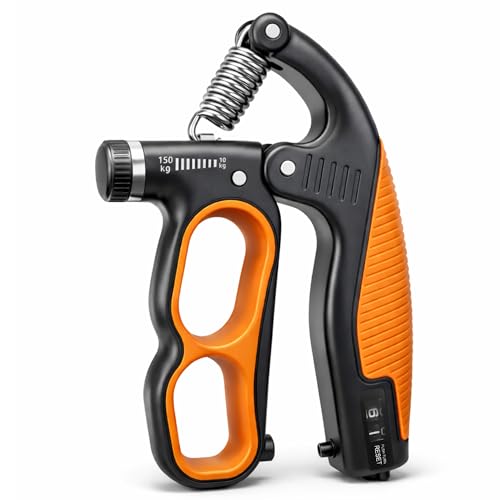
The CoreMuse is the budget pick with the widest claimed ceiling, a 22 to 330 lb range and a no-battery counter.
Best for: the widest resistance ceiling for the least outlay Skip it if: you want a proven fast-moving pick
The CoreMuse is the cheapest of the seven, and it prints the most aggressive number: 22 to 330 lbs. CoreMuse calls it "super-wide" and pitches it at "athletes, rock climbers, musicians." It's the only yellow and black unit here, weighs 0.57 lb and measures 0.1 x 6.7 x 4.3 in, the longest handle span in the set. It also carries the no-battery counter that "tracks your reps automatically."
Here's the honest read. That 330 lb ceiling is exactly the kind of headline number GD warns about, and CoreMuse gives no way to verify it. Treat it as an upper claim, not a guaranteed load. The wide handle and TPE grip are described well, "oversized TPR rubber grip," but those are maker lines too.
Its clearest weakness is momentum: it's the slowest-selling pick here by a wide margin, and only one seller lists it. That's a lot of unknowns to accept for the price. Buy it when you want the biggest claimed range for the least money and you're comfortable that the top end is a claim you can't check.
Pros:
- Cheapest of the seven
- Widest claimed 22–330 lb span
- No-battery mechanical counter
- Longest, oversized handle in the set
Cons:
- 330 lb ceiling unverifiable
- Slowest-moving pick by far
- Only one seller lists it
7. GD PRO-70 Grip Strength Trainer — Best premium
The GD PRO-70 is the premium pick for buyers who want an honest 55 to 154 lb range over an inflated headline number.

Best for: buyers who distrust inflated top-end numbers Skip it if: you need resistance below 55 lbs
The GD PRO-70 is the pick that argues against the whole category's marketing. Its listing states an adjustable 55 to 154 lb range and pointedly claims "honest resistance," calling out rivals whose "maximum resistance of many grippers on Amazon is more than 130lbs" but "feel like toys." It's the most expensive pick here, weighs 5.61 oz and measures 0.8 x 4 x 6.1 in.
GD describes "ultra-compressed steel springs" and says the frame is "safe from breakage," positioning durability as the reason for the price. It also frames the wide span as a saving, arguing you'd need "more than SIX" fixed grippers to match its range. Those are the maker's claims, so weigh them as such.
The obvious limit is the floor. Starting at 55 lbs, it skips warm-ups and rehab entirely, which is why it can't be the overall pick. It sits toward the slower end of this set and only one seller lists it. Buy the PRO-70 when you already have strong hands, distrust triple-digit claims, and want a range you can believe.
Pros:
- Honest, credible 55–154 lb range
- Ultra-compressed steel spring claim
- Positioned as breakage-safe
- One tool replacing several fixed grippers
Cons:
- 55 lb floor skips rehab and warm-ups
- Most expensive pick in the set
- Only one seller lists it
How high is the resistance ceiling, really?
The best heavy duty adjustable grip strengthener isn't the one with the biggest printed number. It's the one whose number you can trust. Here's how the ceilings stack up in this set, read honestly:
- CoreMuse, 330 lbs claim. The highest headline, and the least verifiable. No calibration, slowest-moving pick.
- GD PRO-70, 154 lbs. Lower than CoreMuse but sold on "honest resistance," with the maker openly mocking inflated rivals.
- FitBeast, 132 lbs. A clean, stated top end with a matching low floor.
- AIXPI, 132 vs 110 lbs. The title and the feature text disagree, so read it as the lower figure.
A ceiling is only useful if your hand actually meets that load. Two things bend the real figure: handle width, which changes leverage, and how "resistance" was measured, which no listing spells out. So the practical order runs: trust GD and FitBeast first, treat CoreMuse's 330 lbs as a stretch goal, and read AIXPI at its conservative number. Chase honesty over headline, and you'll end up with a gripper that still challenges you next year.
When a different pick wins
The FitBeast leads most buyers, but four clear conditions flip that.
- If you train both hands at once, the KDG two-pack wins. Two grippers at 3.53 oz total, each with a counter, beats one dialable unit for symmetric work.
- If you want a progression ladder over a dial, the FitBeast 5-pack wins. Five pieces and the only stated warranty here suit steady step-ups.
- If you log every rep, the Hiyoga wins. Its twist-reset counter is built for volume tracking a climber cares about.
- If your hands are already strong and you distrust big numbers, the GD PRO-70 wins. Its 55 to 154 lb range skips the easy end on purpose.
The cutoff that decides most of these is the low floor. Below a 20 lb starting resistance, you can rehab and warm up on the same tool, which points to the FitBeast at 10 lbs or the AIXPI at 11 lbs. Above it, you're buying a specialist, and the GD PRO-70 at 55 lbs is the honest specialist. Match the floor to your weakest day, not your strongest.
The verdict
Two tracks decide this. If you want one adjustable gripper to serve every session, the FitBeast Grip Strengthener is the best heavy duty adjustable grip strengthener here: a stated 10 to 132 lb span, a 5.64 oz body and the fastest movement among single units, with no contradictory range figures to second-guess. It covers your lightest rehab day and your hardest forearm set on the same tool.
If you're already strong and you've been burned by grippers that "feel like toys," the GD PRO-70 is the better buy. Its 55 to 154 lb range starts high on purpose and it's sold on honest, calibrated resistance rather than a headline number. The cutoff between the two tracks is your low floor: need anything under 20 lbs, take the FitBeast; never train below 55 lbs, take the GD.
The CoreMuse tempts with 330 lbs for the least money, but that ceiling is unverifiable and it's the slowest-moving pick, so it's a gamble rather than a default. For two-hand training the KDG pair steps in; for rep logging the Hiyoga does. Start with the FitBeast unless one of those conditions clearly describes you.
FAQ
Is a heavy duty adjustable grip strengthener worth the money?
A heavy duty adjustable grip strengthener is worth it if you'd otherwise buy several fixed-resistance grippers. One dialable unit like the FitBeast spans 10 to 132 lbs, replacing a rack of single-strength tools. GD makes the same case, claiming its range would take "more than SIX" fixed grippers to match. For anyone progressing over months, that span pays for itself.
What resistance range should a beginner look for?
A beginner should look for a low floor, ideally around 10 lbs. The FitBeast starts at 10 lbs and the AIXPI at 11 lbs, so you can warm up and build gradually. Avoid the GD PRO-70's 55 lb floor early on, since it skips the light end entirely. Match the lowest setting to your weakest day, then work upward as strength grows.
How does the FitBeast compare to the GD PRO-70?
The FitBeast compares favourably for range breadth, spanning 10 to 132 lbs against the GD PRO-70's 55 to 154 lbs. The FitBeast serves rehab and heavy work on one tool; the GD starts high and sells itself on honest, calibrated resistance. Choose the FitBeast for a full span, the GD if your hands are already strong and you distrust inflated top-end numbers.
Does the built-in rep counter actually matter?
The built-in rep counter matters if you train to targets or log weekly volume. The Hiyoga, CoreMuse and KDG all include one; the Hiyoga resets with a twist and needs no batteries. If you train by feel or do low-rep heavy singles, it's dead weight. The overall FitBeast pick skips a counter and still leads, so treat it as optional.
Can I trust a gripper claiming 300-plus pounds of resistance?
Trusting a gripper claiming 300-plus pounds means trusting a number you can't verify. The CoreMuse lists 22 to 330 lbs, the widest here, but gives no calibration. GD's own listing warns that many high-claim grippers "feel like toys" when squeezed. Read a huge ceiling as an upper stretch goal, not a guaranteed load, and weigh the more modest, credible ranges first.
If you're picking one gripper today, start with the FitBeast and match its 10 lb floor to your lightest session. That low starting point is the quiet reason it beats grippers with bigger headline numbers: you can warm up, rehab and push hard on the same spring, without owning a drawer of fixed-strength tools. Check the resistance range against your own weakest day, decide whether a counter fits how you train, then open the listing and confirm the current figures for yourself before you commit.