Best Filtered Water Bottle for Campers and Hikers

Six filtered bottles compared for camp use, from a 3.6 oz squeeze filter to an insulated stainless steel flask. One winner, five conditions that flip the pick.

By Alicia RoseUpdated 16 min read
On this page
- Who should skip a filtered bottle entirely
- Best filtered water bottle for campers at a glance
- How I narrowed six picks from the shortlist
- 1. LifeStraw Go Series 1L — Best overall
- 2. LifeStraw Peak Squeeze 22 oz — Best upgrade
- 3. Katadyn BeFree AC 1L — Best premium
- 4. Brita Stainless Steel Premium 20 oz — Most versatile
- 5. Brita Hard-Sided 26 oz — Best budget pick
- 6. Camco Tastepure RV Filter — Best warranty
- Hollow fiber, carbon or both: what each filter actually removes
- How heavy is too heavy in a pack?
- What the listings do not tell you about camp water
- Bottle vs inline filter: which one belongs in your kit?
- The verdict
- FAQ
The best filtered water bottle for campers is the LifeStraw Go Series 1L, a 0.59 lb bottle with a hollow-fiber membrane the brand rates for up to 4,000 L and a carbon filter for taste, which handles both treated taps and questionable backcountry sources. If your priority is packing flat in a hip belt, the LifeStraw Peak Squeeze at 3.6 oz is the better buy.
Who should skip a filtered bottle entirely
Not every camper needs one. If you're pulling into a state park with a chlorinated spigot next to your tent pad, a plain insulated bottle plus a boil-if-in-doubt habit does the job. If you're relying on gravity filters or pump systems at a base camp with four people, a personal bottle filter is redundant and slow.
Where a filtered bottle earns its place is the middle ground: solo or paired campers who cross between treated and untreated water in the same trip. That's the actual use case behind the best filtered water bottle for campers question. A weekend backpacker who fills a hydration reservoir at the trailhead tap, then tops up at a stream two ridges in, is the target buyer.
A few honest disqualifiers:
- If your only water is a chemically contaminated source (agricultural runoff, mine tailings, saltwater), no bottle here removes heavy metals or salt.
- If you need to purify against viruses in international travel water, hollow-fiber membranes on their own don't cover that. Read the filter claims on the listing before trusting a bottle abroad.
- If your camping is exclusively RV-hookup with a garden-hose spigot, an inline filter on the hose is a smarter buy than a bottle.
Everyone else, keep reading.
Best filtered water bottle for campers at a glance
| Pick | Filter type | Weight | Price |
|---|---|---|---|
Best overall LifeStraw Go Series 1L |
Hollow fiber + carbon | 0.59 lb | Check Price |
Best upgrade LifeStraw Peak Squeeze 22 oz |
Hollow fiber membrane | 3.6 oz | Check Price |
Best premium Katadyn BeFree AC 1L |
0.1 micron hollow fiber (2-stage) | 2.24 oz | Check Price |
Most versatile Brita Stainless Steel 20 oz |
Activated carbon block | 0.9 lb | Check Price |
Best budget pick Brita Hard-Sided 26 oz |
Activated carbon block | 7.68 oz | Check Price |
Best warranty Camco Tastepure RV Filter |
GAC + KDF inline | 1 lb | Check Price |


How I narrowed six picks from the shortlist
Three criteria did the cutting, in this order.
- The filter has to work on the water a camper actually meets. That splits the set immediately. Hollow-fiber membranes handle bacteria, parasites and microplastics from wild sources. Activated carbon handles taste and chlorine from treated taps. Two picks here do both, three do one, one is an inline filter for a hose.
- Weight and pack shape. A 0.9 lb insulated bottle is fine at a picnic table. It's a punishment at mile eight. I flagged weight down the column so the trade-off is legible.
- A published spec sheet. I dropped any listing that hid basic dimensions or filter life. Every product here publishes size, weight and either a filter capacity or a replacement interval.
Two things I deliberately did not weight. First, colour options: they don't decide anything. Second, brand loyalty: LifeStraw shows up twice because two of their bottles solve two different problems, not because of the name.
The result is a set that answers different camping questions rather than six versions of the same answer. That's the point of ranking rather than listing.
1. LifeStraw Go Series 1L — Best overall
A 1 L bottle with a two-stage filter that handles both a suspect campground tap and a clear stream, at a weight that still fits a day pack.
Best for: campers filling from taps, streams and questionable spigots Skip it if: you count every ounce on a thru-hike
The LifeStraw Go Series is the pick I'd default to for the best filtered water bottle for campers question because it doesn't force a choice between wild-water safety and taste. LifeStraw says the membrane microfilter blocks 99.999999% of bacteria including E. coli and Salmonella, and 99.999% of parasites including Giardia and Cryptosporidium, with a stated lifespan up to 4,000 L. The carbon filter is rated by the brand for 26 gallons (100 L), roughly two months of daily use, and targets chlorine and organic taste.
At 0.59 lb and 11 x 3.54 x 3.54 in, it slides into a standard bottle pocket and holds a real liter, so a hot afternoon between refills is realistic. It was released in 2023 and carries a manufacturer warranty. The trade-off against the Peak Squeeze is weight and rigidity: this is a hard bottle. Against the Katadyn BeFree, you get carbon filtration for taste at the cost of ounces.
Pros:
- Two-stage filter covers wild water and treated taps
- Full 1 L capacity between refills
- Manufacturer-stated 4,000 L membrane life
- Carbon layer targets chlorine and odours
- Fits a standard side pocket at 3.54 in wide
Cons:
- Heaviest LifeStraw here by a wide margin
- Hard body doesn't collapse for stowage
- Carbon element needs swapping every two months
2. LifeStraw Peak Squeeze 22 oz — Best upgrade
A 3.6 oz collapsible squeeze filter that packs flat, drinks direct from streams, and doubles as a gravity source at camp.

Best for: backpackers who want a squeeze filter that packs flat Skip it if: you need an insulated bottle for day-to-day use
Step up from the Go Series and this is the shape of the upgrade: less bottle, more filter. At 3.6 oz and 8.7 x 4.8 x 2.99 in, the Peak Squeeze is the second-lightest option here, beaten only by the Katadyn. It's a 22 oz collapsible pouch with a screw-on filter. Fill from a stream, screw on the top, drink. LifeStraw claims the same 99.999999% bacteria and 99.999% parasite reduction as the Go, and says the re-engineered membrane handles sand and silt better with a custom backwash accessory.
Where this earns "upgrade" over the Go is versatility per gram. The listing describes pushing water through it into cooking containers or other drinkware, which turns it into a make-shift gravity or camp filter. It's also 2x thicker premium materials by LifeStraw's account, which matters because a collapsible bag near tent pegs and rocks lives dangerously. Against the Go, you lose carbon filtration and rigid structure. Against the Katadyn BeFree, you gain a screw-thread filter that fits other bottles.
Pros:
- 3.6 oz total weight
- Collapses flat when empty
- Screws onto standard bottle threads
- Same LifeStraw filter claims as the Go
- Backwash accessory for silty sources
Cons:
- No carbon filter, so treated tap water still tastes chlorinated
- Squeeze pouches are less durable than hard bottles
- Slower to drink than a straw bottle
3. Katadyn BeFree AC 1L — Best premium
A 2.24 oz ultralight bottle with a 0.1 micron hollow fiber membrane, from a filter brand trading on nearly a century of practice.

Best for: ultralight hikers who fill from streams and lakes Skip it if: your water source is chlorinated tap
Weight is what wins this category on paper. At 2.24 oz the Katadyn BeFree AC is the lightest bottle here by a factor of four against the Go Series, and by ten against the Brita Stainless. Katadyn says the 0.1 micron hollow fiber membrane delivers up to 2 L per minute of flow, with a stated capacity of 1,000 L. The listing describes cleaning as a shake or swish in water, no backflushing or tools required.
It sits at the most expensive slot in this set, which is where the premium label comes from. That price buys the lowest carry weight of the six and a brand the listing dates to 1928. What you don't get is a carbon element, so if the target water is municipal tap, the BeFree will filter particulates but not chlorine taste. It also doesn't include a Model warranty spec beyond the standard manufacturer warranty, and dimensions of 10 x 4.25 x 3 in mean it collapses but doesn't disappear.
Pros:
- Lightest pick here at 2.24 oz
- 2 L per minute flow rate claim
- 0.1 micron hollow fiber membrane
- Rinse-clean, no backflush needed
- Collapses for stowage
Cons:
- No carbon filter for taste
- The most expensive pick here
- Soft body needs careful stowage
4. Brita Stainless Steel Premium 20 oz — Most versatile
A 20 oz insulated stainless bottle that keeps water cold for a full 24 hours by Brita's account, and swaps into daily commuter use.
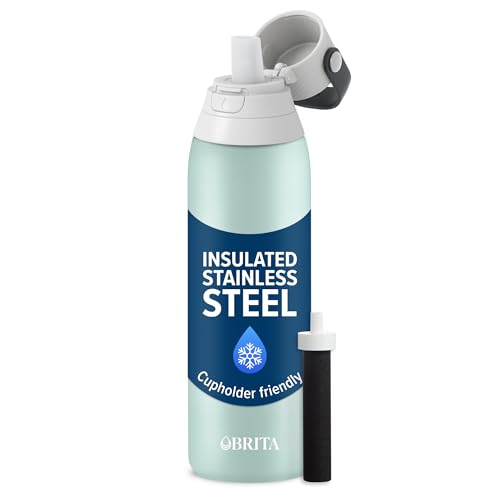
Best for: car campers who want cold water in camp and filtered tap at home Skip it if: the source is wild water rather than municipal
This is the one to buy if your camping is treated-water camping and the bottle needs a second job. Brita says the activated carbon block filter reduces chlorine taste and odour and cuts particulates, and explicitly calls out that it's not a water purifier bottle. Read: don't take it to a stream. What it does have is double-wall insulation with a 24-hour cold retention claim, which no other pick here offers.
At 0.9 lb and 10.8 x 3.23 x 3.23 in it's the heaviest bottle in this set, which is the honest cost of the stainless steel. The filter is rated by Brita at 40 gallons or two months, whichever comes first. It also carries the clearest warranty in the group: a 30-day money-back guarantee spelled out on the listing. The versatile label fits because this is the pick you'd actually use fifty weeks a year at a desk and two weeks at a campsite with a spigot.
Pros:
- 24-hour cold retention claim from Brita
- Double-wall stainless steel construction
- Push-button lid, one-handed
- Explicit 30-day money-back guarantee
- Straw-drink design with carrying loop
Cons:
- Heaviest bottle here at 0.9 lb
- Carbon filter only — no protection from wild-source pathogens
- Filter needs swapping every 40 gallons
5. Brita Hard-Sided 26 oz — Best budget pick
A 26 oz plastic bottle with the same Brita carbon filter as the stainless model, at the cheapest position in this set.

Best for: weekend campers on treated water who want the lightest spend Skip it if: you fill from creeks or unknown wells
This is the cheapest of the six and the largest at 26 oz. Brita fits the same activated carbon block filter here as in the stainless version, with the same 40-gallon or two-month lifespan claim. At 7.68 oz it's actually lighter than the stainless Brita by a meaningful margin, because you're carrying plastic instead of steel. The listing also notes it's top-rack dishwasher safe, which the wild-water filters here decidedly are not.
The best filtered water bottle for campers on a budget is this one, provided the modifier fits your trip. Same limitation as the stainless: carbon filter only, taste and particulates. This is not a wild-water bottle. What it is, is a large-capacity, cheap, easy-to-clean way to make campground tap water taste like it wasn't sitting in a hose. Against the LifeStraw Go, you save cash and lose the wild-water safety net. Against the stainless Brita, you lose insulation and 2.7 oz.
Pros:
- Cheapest pick here
- Largest capacity at 26 oz
- Top-rack dishwasher safe
- Same 40-gallon filter life claim
- Lighter than the stainless Brita at 7.68 oz
Cons:
- Plastic body, no insulation
- Carbon-only filtration — not for stream water
- Filter replacements are an ongoing cost
6. Camco Tastepure RV Filter — Best warranty
An inline hose filter, not a bottle, for RV campers who want cleaner spigot water at the source rather than the sip.

Best for: RV campers hooking up to campground spigots Skip it if: you're hiking away from the vehicle
This is the odd one out. The Camco Tastepure isn't a bottle, it's a 10.5 x 2.5 x 2.5 in inline filter that screws onto a garden or drinking hose. It's here because a big share of readers searching for the best filtered water bottle for campers are actually asking a different question: how do I make campground water taste like water? For RV campers, this is a better answer than a bottle.
Camco publishes the most specific warranty in the group: a limited 1-year warranty with an address, an email and terms in plain language. The listing claims Hex-Flow Technology with a 6-step filtration process using GAC and KDF media, and says the unit is independently tested and listed to NSF/ANSI 42 and NSF/ANSI 53 for taste and lead reduction. It's the one buyers choose most often in this set by a wide margin, which reflects the RV rather than the backpacking audience. Against every bottle here, it fails as a personal hydration tool. As a spigot filter, nothing else in the set competes.
Pros:
- Explicit 1-year written warranty
- Attaches to any standard hose
- NSF/ANSI 42 and 53 listing claim
- GAC and KDF media, not just carbon
- Treats water at the source, not sip by sip
Cons:
- Not a bottle — you can't carry it hiking
- 1 lb of dead weight in a pack
- Single-purpose for RV or vehicle camping
Hollow fiber, carbon or both: what each filter actually removes
The filter technology is what separates a bottle you can drink from a stream from a bottle that just makes tap water taste better. Two of the picks here use hollow fiber membrane filters. Two use activated carbon block filters. The Go Series uses both. The Camco uses a GAC-plus-KDF combination.
Here's the short version:
- Hollow fiber membranes physically block bacteria, parasites, microplastics and sediment down to about 0.1 microns. LifeStraw and Katadyn both claim reductions in the 99.999% to 99.999999% range for the pathogens listed. They do nothing for chlorine taste, dissolved chemicals or heavy metals.
- Activated carbon adsorbs chlorine, odours, some organic chemicals and reduces particulates. Brita is explicit that its bottle filters are not water purifiers. That's the honest label. Carbon alone is a taste-and-particulate tool, not a pathogen tool.
- Two-stage bottles stack both. The LifeStraw Go combines carbon with a membrane, which is why it wins the overall slot: it addresses the two problems most campers face across a single trip.
If you fill only from tested taps, carbon alone is enough. If you fill from any wild source, you need the membrane. If you cross between the two, the two-stage design earns its weight.
How heavy is too heavy in a pack?
Weight is where the rankings really move. Six picks, six weights, all on the input spec sheet:
- Katadyn BeFree AC — 2.24 oz
- LifeStraw Peak Squeeze — 3.6 oz
- Brita Hard-Sided 26 oz — 7.68 oz
- LifeStraw Go Series 1L — 0.59 lb (9.44 oz)
- Brita Stainless Steel 20 oz — 0.9 lb (14.4 oz)
- Camco Tastepure — 1 lb
The spread from lightest to heaviest is more than six-fold. For a day hike, any of these is fine. For a two-day backpacking trip, the two Brita bottles are difficult to justify unless you also want the stainless as a general-use bottle. For anything longer, the Peak Squeeze and BeFree are the honest answers.
The trick most shoppers miss: capacity per ounce matters more than raw weight. The BeFree carries 1 L at 2.24 oz. The Peak Squeeze carries 22 oz at 3.6 oz. Those are similar ratios. The Brita Stainless carries 20 oz at 14.4 oz of bottle. That ratio is why an insulated bottle is a car-camping tool, not a backpacking tool.
What the listings do not tell you about camp water
Three things you'll want to know before you buy, none of which appear in the specs.
Filter clogging is what actually kills these bottles. Membrane filters don't wear out from time, they wear out from silty water. The Peak Squeeze listing mentions a backwash accessory for a reason. If you fill from a muddy stream, drink flow slows fast. Pre-filter through a bandana or let the water settle in a pot for a few minutes.
Freezing wrecks hollow fiber membranes. A single freeze cycle can crack the tiny fibers inside and open pathways you can't see. The bottle looks fine and no longer filters. If you camp in shoulder seasons, sleep with the bottle in your bag.
Carbon filters have a shelf life whether you use them or not. Brita rates its filters at two months or 40 gallons. That's not marketing conservatism — carbon adsorbs air contaminants too, so a filter that lived in a cupboard for six months is spent. Note the install date on the filter with a marker.
None of these matter for a single weekend. All three matter for anyone using a filtered bottle across a season.
Bottle vs inline filter: which one belongs in your kit?
This is the question the Camco pick raises, and it deserves an honest answer.
- If you're tent camping and walking to a spigot with a bottle, buy a bottle. An inline filter needs a hose.
- If you're in an RV or trailer with a hose hookup, the Camco does more work than any bottle. It treats every drop that reaches your sink, your kettle and your shower, not just the sip you filter in the bottle.
- If you're doing both, buy both. The Camco lives on the RV connection. A LifeStraw Go or Peak Squeeze lives in the day pack for hikes off-vehicle.
The most common mistake is buying an inline filter and expecting it to solve backcountry hydration. It cannot. It also cannot travel with you on a hike. The reverse mistake — buying a bottle and running your RV water unfiltered — is more forgivable but leaves a lot on the table for the price of one inline unit.
The verdict
The best filtered water bottle for campers is the LifeStraw Go Series 1L. It's the only bottle here that handles both wild-source pathogens and treated-tap taste in one unit, at 0.59 lb with a manufacturer-claimed 4,000 L membrane life and a 100 L carbon filter. That combination is what most campers actually need across a trip that crosses water sources.
Two conditions flip the pick. If your camping is ultralight and every ounce is counted, the Katadyn BeFree AC at 2.24 oz is the correct answer. It gives up carbon filtration for a weight the Go can't match, and Katadyn has published a 1,000 L membrane capacity to back it up. If your camping is car-based and you want a bottle you'll also use at a desk, the Brita Stainless Steel 20 oz is the versatile pick — a 24-hour cold claim and an explicit 30-day money-back guarantee, at the cost of not being safe on wild water.
The runner-up in the overall race is the LifeStraw Peak Squeeze. Its 3.6 oz weight and screw-thread filter design make it the more flexible tool. It loses to the Go on carbon filtration and rigid structure, both of which matter more for a general-purpose camp bottle than for a backpacking-specific one.
FAQ
What filter type is best for camping water?
Best for camping water depends on the source. A hollow-fiber membrane, like the ones in the LifeStraw Go, Peak Squeeze and Katadyn BeFree, blocks bacteria, parasites and microplastics down to around 0.1 microns and is the right tool for streams, lakes and unknown wells. Carbon filters, like the Brita units, handle chlorine taste and particulates in treated tap water. A two-stage design covers both.
Is a filtered water bottle worth it for weekend camping?
A filtered water bottle is worth it for weekend camping if your water source is anything other than a tested municipal tap. Even at treated campgrounds, hose water often tastes of chlorine and old rubber, which a Brita bottle solves. If you'll cross onto trails and refill from a stream, only the membrane bottles — LifeStraw and Katadyn — are safe choices for that use.
How long do these filters actually last?
How long these filters last is on each listing. LifeStraw says the Go Series membrane goes up to 4,000 L, about five years of daily use, with a 100 L carbon element good for around two months. The Peak Squeeze uses the same membrane spec. Katadyn rates the BeFree at 1,000 L. Brita rates its carbon filters at 40 gallons or two months, whichever comes first.
LifeStraw Go vs Peak Squeeze: which one for camping?
LifeStraw Go vs Peak Squeeze comes down to bottle shape and taste filtration. The Go Series is a 1 L hard bottle at 0.59 lb with an added carbon filter, so it handles treated tap water taste as well as wild sources. The Peak Squeeze is a 22 oz collapsible pouch at 3.6 oz, membrane only, that packs flat. Choose the Go for one-bottle-does-everything; choose the Peak Squeeze for weight.
What is the biggest mistake when buying a filtered bottle?
The biggest mistake when buying a filtered bottle is assuming any filter handles any water. Carbon-only bottles like both Britas are explicitly not purifiers and won't stop pathogens from wild sources. Hollow-fiber-only bottles like the Katadyn BeFree won't remove chlorine taste from tap water. Match the filter type to the water source you'll actually meet, not to the marketing photo on the box.
Grab the LifeStraw Go Series if you want one bottle that covers the widest range of camp water without further thinking. Its two-stage filter is what makes it the right default: the membrane keeps wild sources honest, the carbon layer makes treated water drinkable, and 1 L of capacity means fewer stops on a long afternoon. If your camping is more specific than "camping" — ultralight, RV-only, treated-tap-only — one of the other five picks fits your trip better than the winner does. Match the filter to the water, and the bottle will do the rest.