Best Commercial Grade Plyo Box for a Cramped Garage

Five plyo boxes compared on footprint, height range and build material, with the deciding spec named up front and the flip conditions spelled out for tight rooms.

By Alicia RoseUpdated 15 min read
On this page
- Best commercial grade plyo box for small spaces at a glance
- How I screened this field down to five
- Which spec actually decides a plyo box?
- 1. VEVOR Plyometric Jump Boxes — Best overall
- 2. Amazon Basics 3-in-1 Wooden Plyo Box — Best for small spaces
- 3. BalanceFrom 3-in-1 Foam Plyo Jump Box for Home Gym — Best budget pick
- 4. Fitvids 24 x 20 x 16 Non-Slip Plyo Box Jump Exercise — Best for beginners
- 5. JFIT Plyometric Jump Box-24" Height — Best premium
- Does any of these genuinely suit a tight room?
- Wood, steel or foam: what changes for you?
- What more money buys in this set
- The verdict
- FAQ
The best commercial grade plyo box for small spaces is the VEVOR Plyometric Jump Boxes set, because one 24 x 22.6 x 22.6 in footprint gives you 12, 18 and 24 in jump heights. If you have only one corner to spare and want a single box rather than three nesting shells, the Amazon Basics 3-in-1 Wooden Plyo Box gets you three heights out of a 16 x 23.7 x 20 in body. Height range is what splits this field. Every box here tops out at 24 in, so the real question is how many usable heights you get per square foot of floor, and how many pieces you have to store to get them.
Best commercial grade plyo box for small spaces at a glance
| Pick | Heights | Footprint | Price |
|---|---|---|---|
Best overall VEVOR Plyometric Jump Boxes |
12 / 18 / 24 in 3 boxes |
24 x 22.6 x 22.6 in | Check Price |
Best for small spaces Amazon Basics 3-in-1 Wooden Plyo Box |
16 / 20 / 24 in 1 box, flip |
16 x 23.7 x 20 in | Check Price |
Best budget pick BalanceFrom 3-in-1 Foam Plyo Jump Box |
16 / 20 / 24 in 1 box, flip |
20 x 24 x 16 in | Check Price |
Best for beginners Fitvids Non-Slip Plyo Box |
16 / 20 / 24 in 1 box, flip |
24 x 16 x 20 in | Check Price |
Best premium JFIT Plyometric Jump Box 24" |
24 in only 1 box |
24 x 21 x 21 in | Check Price |



How I screened this field down to five
I started from the listing data for jump trainers and step platforms, then compared published specifications side by side rather than trusting the marketing headline on each box.
Three screens did the work:
- A published footprint. No dimensions, no pick. Every box here states its size in inches, which is the only way to judge whether it fits a spare corner.
- A stated height at 24 in or above. That's the standard target height for adult box jumps, and every survivor hits it.
- A stated load figure or a stated build material. Four of the five publish a weight capacity in their feature copy. The fifth publishes an iron bar construction claim instead.
What that left is a genuinely mixed field: one three-piece wooden set, two single flip boxes in plywood, one steel frame with pads, one foam block. That spread is deliberate. The best commercial grade plyo box for small spaces isn't one shape, because a foam box and a steel frame solve different problems in the same square footage.
What got cut most often was soft-sided boxes with no published dimensions at all, and step platforms that never reach 24 in. Neither belongs in a comparison where floor area is the constraint.
Which spec actually decides a plyo box?
Most guides compare weight capacity. That's the wrong lead. Four of these five claim 350 lb or more, which covers almost every adult plus the barbell they'd never be holding on a box jump anyway. Capacity is table stakes here, not a tiebreaker.
Heights per footprint is the deciding number. A plyo box occupies floor whether you're using it or not. The question is how much training range that floor buys.
Run the maths on the set:
- VEVOR: three heights, 12 / 18 / 24 in, from a 24 x 22.6 x 22.6 in stack of nesting boxes.
- Amazon Basics: three heights, 16 / 20 / 24 in, from a 16 x 23.7 x 20 in single body.
- Fitvids: three heights from a 24 x 16 x 20 in body.
- BalanceFrom: three heights from a 20 x 24 x 16 in foam block.
- JFIT: one height, 24 in, from a 24 x 21 x 21 in frame.
Four of the five give you three heights. Only one gives you a starting height as low as 12 in, and that's the VEVOR set. If you're rehabbing a knee or coaching a nervous beginner, a 12 in first rep matters more than a 24 in ceiling. That's the gap the specification sheet exposes and the marketing copy hides.
1. VEVOR Plyometric Jump Boxes — Best overall
Three separate boxes at 12, 18 and 24 in give this set the widest usable height range here, and they nest into a single 24 x 22.6 x 22.6 in footprint.
Best for: a lifter who wants 12, 18 and 24 in heights without swapping equipment Skip it if: you only have one small corner of floor to spare
The count field says three, and that's the whole argument. Every other pick here is a single body that flips. VEVOR gives you separate boxes, which means a partner can work at 12 in while you work at 24 in, and it means the 12 in step is available at all. No other pick in this set starts below 16 in.
The trade-off is mass and volume. At 39.7 lb across the set, this is the heaviest listing here by a clear margin, and the nested stack measures 24 x 22.6 x 22.6 in. VEVOR describes a trapezoidal structure, four rubber pads underneath and a textured silicone top surface, and says assembly is a matter of tightening components to the instructions. Those are the manufacturer's claims, not measured figures.
Sales data puts it ahead of three of the other four picks here, so it isn't a fringe choice. It also sits in the more expensive half of this group, and only one seller lists it. If your idea of a small space is a closet shelf, three boxes is three boxes.
Pros:
- Only pick here with a 12 in starting height
- Three separate boxes, usable by two people at once
- Nests into one 24 x 22.6 x 22.6 in footprint
- Rubber base pads and textured silicone top claimed
- Sells faster than most of this set
Cons:
- 39.7 lb total, the heaviest listing in the group
- Three pieces to store rather than one
- No published warranty in the listing
- Only one seller stocks it
- Requires assembly, unlike the JFIT
2. Amazon Basics 3-in-1 Wooden Plyo Box — Best for small spaces
A 16 x 23.7 x 20 in single body with three flip heights and built-in handles, which is the tightest three-height package here.

Best for: one box, one footprint, three heights in a shared room Skip it if: you want a jump surface taller than 24 in
This is the pick I'd start with for a room that does other jobs. One body, three heights at 24, 20 and 16 in, and a listed 16 x 23.7 x 20 in envelope. Rotate it, you get a different height. Nothing else to store.
Two details separate it from the other flip boxes. Amazon Basics lists built-in wide handles for repositioning, and it lists clear height indicators printed on the box so you know which face is up before you jump. Small things, but a mid-set you don't want to guess. The listing also claims 450 lb support, smooth sanded edges, and pre-drilled plus pilot holes for assembly.
It's the fastest seller of the five and one of two picks with more than a single seller. Released in 2025, so it's the newest listing here.
The honest limitation is the 24 in ceiling and the flip mechanic itself. Flipping a plywood box between sets costs seconds every time, and a training partner can't use a second height while you use the first. That's the price of the small footprint.
Pros:
- Three heights from a single 16 x 23.7 x 20 in body
- Built-in wide handles for repositioning
- Printed height indicators on each face
- 450 lb support claimed by the listing
- The box buyers here choose most often
Cons:
- Tops out at 24 in, like every pick here
- No published warranty, unlike the Fitvids
- Flipping between heights interrupts a circuit
- No stated weight, so shipping bulk is unknown
3. BalanceFrom 3-in-1 Foam Plyo Jump Box for Home Gym — Best budget pick
The only foam box here, which means a missed rep bruises your ego instead of your shin.

Best for: shin-scraping beginners and anyone training over a downstairs neighbour Skip it if: you weigh close to 350 lb or plan to load a barbell overhead nearby
This is the cheapest of the five and the only one that isn't plywood or steel. High-density foam under a PVC exterior, per BalanceFrom, with a flip design giving 16, 20 and 24 in from a 20 x 24 x 16 in body. The listing claims shock absorption to reduce joint impact and a textured non-slip PVC surface.
Foam changes the risk profile of the whole exercise. Clip a plywood edge at 24 in and you take skin off. Clip foam and you slide off. For anyone new to box jumps, that difference decides whether you keep training the movement or quietly stop.
Two data points to weigh. The stated capacity is 350 lb, the lowest published figure in this set, where three others claim 450 lb. And the size field lists 10 lb, while the weight field reads 0 g, so I'd treat the shipping weight as unconfirmed.
Foam also compresses. A wooden box gives you the same take-off surface in year three; a soft top absorbs some of the drive you're trying to train. That's the trade against the plywood picks.
Pros:
- Cheapest pick in this group
- Only foam-faced option, easier on shins
- Three heights from one 20 x 24 x 16 in body
- Quietest landing surface of the five
- PVC textured top for traction, per the listing
Cons:
- 350 lb claimed capacity, the lowest here
- Conflicting weight figures in the listing
- Soft surface absorbs some take-off drive
- No published warranty
- Only one seller lists it
4. Fitvids 24 x 20 x 16 Non-Slip Plyo Box Jump Exercise — Best for beginners
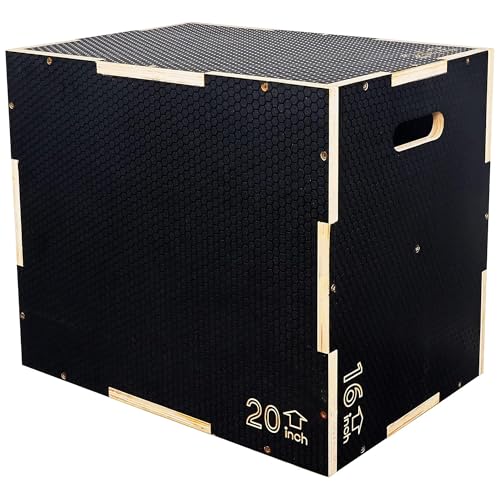
The only pick in this set with a published warranty: 2 years from the manufacturer.
Best for: a first plyo box with a published warranty behind it Skip it if: you want handles moulded into the panels
Four of these five listings publish nothing about warranty coverage. Fitvids publishes 2 years. For a first plyo box, bought by someone who isn't yet sure they'll stick with box jumps, that's worth more than another spec bullet.
The construction detail is the puzzle joints. Fitvids says high-quality plywood with interlocking puzzle joints and a 450 lb weight capacity, and quotes about 10 minutes to assemble. Interlocking panels spread load across the joint rather than relying on the screws alone, which is the standard approach on a wooden box you land on repeatedly. The listing also claims a slip-free top surface.
Dimensions come in at 24 x 16 x 20 in, so heights of 24, 20 and 16 in from a single flipping body, the same pattern as the Amazon Basics and BalanceFrom picks.
It's the second-cheapest here, which is a good position for a starter box. Against the Amazon Basics, though, it gives up the built-in handles and the printed height markers, and it's the slowest seller of the three plywood flip boxes in this group.
Pros:
- Only pick with a stated 2 year manufacturer warranty
- Puzzle-joint plywood construction claimed
- 450 lb capacity per the listing
- Second-cheapest of the five
- About 10 minutes to assemble, per Fitvids
Cons:
- No handles listed for repositioning
- No printed height indicators
- No published weight figure
- Sells more slowly than the Amazon Basics
- Only one seller stocks it
5. JFIT Plyometric Jump Box-24" Height — Best premium
Arrives fully assembled with no tools required, and at 15 lb it's the lightest box here that still stands 24 in tall.

Best for: someone who wants it out of the carton and usable in two minutes Skip it if: you need more than the single 24 in height
Every other pick in this set needs building. JFIT says this one doesn't: fully assembled, no tools, and the listing argues that a welded frame beats a bolt-together box on structural integrity. Take that as the manufacturer's position rather than a tested result, but the assembly claim itself is checkable the moment the carton opens.
The frame is heavy-duty iron bar, per JFIT, with high-traction landing pads fastened around the edges to stop rolling, shifting or peeling. At 15 lb and 24 x 21 x 21 in, it's the lightest 24 in box here by 24.7 lb against the VEVOR set. Easy to slide out of a doorway.
Then the catch: one height. The count is 1, the size is 24 in, and there's no flip. JFIT lists 6, 12, 18 and 24 in as separate purchases, so covering a range means buying more boxes.
It's the most expensive pick here and the slowest seller of the five by a wide gap, and it buys you no extra published height capability over the mid-priced Amazon Basics. That's a hard combination to defend unless assembly-free steel is specifically what you want.
Pros:
- Ships fully assembled, no tools needed
- 15 lb, the lightest 24 in box in this set
- Iron bar frame construction claimed
- Edge-fastened non-slip landing pads
- Compact 24 x 21 x 21 in footprint
Cons:
- Single 24 in height, no flip or step-down
- Most expensive pick here for the fewest heights
- No published load capacity figure
- No published warranty
- Slowest seller of the five by a wide margin
Does any of these genuinely suit a tight room?
Partly, and that word matters. Amazon's search returns these boxes for a small-space query, but no listing here publishes a folding or collapsing dimension. A plyo box is a solid object roughly 2 ft in every direction. You have to judge the fit yourself, with a tape measure, against the corner you actually have.
What the data lets you compare is total volume and piece count:
- Smallest single body: Amazon Basics, 16 x 23.7 x 20 in.
- Lightest: JFIT at 15 lb, easy to move daily.
- Most heights per body: the three flip boxes, three each from one shell.
- Most pieces to store: VEVOR, three boxes at 39.7 lb combined.
My practical test: measure your clear floor, then subtract 3 ft on the landing side. You need somewhere to step down. A box that fits the corner but leaves you jumping toward a squat rack isn't a small-space solution, it's a hazard.
If the box lives in a shared room, weight and handles decide more than dimensions. That's where the Amazon Basics handles and the JFIT's 15 lb earn their keep.
Wood, steel or foam: what changes for you?
Three materials, three different failure modes. Pick the one whose downside you can live with.
Plywood is what most commercial boxes use, and three picks here run it: Amazon Basics, Fitvids and VEVOR. Rigid take-off surface, high published capacities at 450 lb, and no compression over time. The cost is skin. A missed rep on a plywood edge hurts.
Steel, meaning the JFIT frame, trades weight for rigidity. At 15 lb it's the easiest to reposition, and the padded top edges are there to stop the landing surface peeling. The limitation is the fixed 24 in height.
Foam, the BalanceFrom, is the forgiving one. Shock-absorbing per the listing, quiet on landing, and the pick I'd hand a nervous beginner. Two trade-offs: the 350 lb claimed capacity is the lowest here, and foam yields under the take-off you're trying to train.
Sequence, if you're building over time: foam first, plywood second, extra heights third.
What more money buys in this set
Not much, once you get past the entry tier, and the ranking below is where that shows.
The cheapest pick, BalanceFrom, still gives three heights and a claimed 350 lb capacity. The second-cheapest, Fitvids, adds plywood at a claimed 450 lb and the only published warranty here. So the entry tier already covers the fundamentals.
Move to the middle and the Amazon Basics buys refinement rather than capability: handles, printed height markers, the smallest single-body footprint, and a second seller stocking it.
The two most expensive picks split. VEVOR buys you a genuine capability jump, three separate boxes and a 12 in bottom step nothing else here offers. JFIT buys assembly-free steel and 15 lb, but drops to a single height while sitting at the top of the price range.
Spend up for the VEVOR if you want the height range. Spend up for the JFIT only if you specifically want no assembly.
The verdict
If you want the widest training range from one purchase, buy the VEVOR Plyometric Jump Boxes. Three separate boxes at 12, 18 and 24 in nest into a 24 x 22.6 x 22.6 in footprint, and the 12 in step is something no other pick here provides. If your floor space is genuinely the binding constraint and you can only store one object, buy the Amazon Basics 3-in-1 Wooden Plyo Box. Three heights, a 16 x 23.7 x 20 in body, handles built in, and printed markers so you know which face is up.
The cutoff is storage, not price: if you can leave three nesting boxes in a corner, take the VEVOR; if the box has to disappear behind a door, take the Amazon Basics.
Two conditions flip both answers. If you're new to box jumps and worried about clipping an edge, the foam BalanceFrom is the right first box regardless of footprint. If you refuse to assemble anything, the JFIT arrives ready at 15 lb, and you accept a single 24 in height in exchange.
The Amazon Basics runner-up advantage over the VEVOR is precise: one body instead of three, in less volume, with handles.
FAQ
Is a commercial grade plyo box worth it for a home gym?
A commercial grade plyo box is worth it if you jump more than once a week. Three of these five publish a 450 lb support claim, well above what a lifter loads onto it. That margin is what stops flex at the joint after a few hundred reps. Occasional step-ups don't need it; regular explosive work does.
What is the best commercial grade plyo box for small spaces on a tight budget?
The best commercial grade plyo box for small spaces on a tight budget is the BalanceFrom foam box. It's the cheapest of the five, still delivers 16, 20 and 24 in from one 20 x 24 x 16 in body, and its foam construction is gentler on shins than plywood. Accept the 350 lb claimed capacity, the lowest published figure in this group.
VEVOR or Amazon Basics: which should I pick?
VEVOR or Amazon Basics comes down to pieces versus range. VEVOR gives three separate boxes at 12, 18 and 24 in, so a partner can train alongside you and the 12 in step exists. Amazon Basics gives three heights from one 16 x 23.7 x 20 in shell with handles. Choose VEVOR for range, Amazon Basics for storage.
How much height do I actually need on a plyo box?
The height you actually need is usually less than 24 in. Every box here reaches 24 in, which is the common adult target, but progress comes from clean landings at a manageable height rather than a taller ceiling. That's why a 12 in or 16 in starting face matters. VEVOR is the only pick here that starts at 12 in.
What mistake do first-time plyo box buyers make?
The mistake first-time plyo box buyers make is measuring the box and forgetting the landing zone. You need clear floor to step down onto, roughly 3 ft on the working side. The second mistake is chasing capacity figures. Between a 350 lb and a 450 lb claim, neither is close to your bodyweight, so decide on heights and material instead.
Get the tape measure out before you order anything. Measure the corner, subtract the step-down space, then match what's left against the footprints in the table above. If three nesting boxes fit, the VEVOR set gives you a 12 in first rep and a 24 in target from the same square of floor, and that range is what keeps the box in use after the novelty fades. If only one body fits, the Amazon Basics does the same job in a smaller envelope with handles to shift it. Either way, buy for the height you'll land cleanly today, not the one you're aiming at.