Best Commercial Grade Exercise Ball by Burst Rating

Five exercise balls compared on the numbers the listings actually publish: static load ratings, anti-burst figures, diameters and warranty terms. The 85 cm Black Mountain Pro Series leads, with cheaper picks that win under specific conditions.
By Alicia RoseUpdated 15 min read
On this page
- Best commercial grade exercise ball at a glance
- What does commercial grade actually mean on a listing?
- How I screened these five and what the criteria were
- 1. Black Mountain Products Professional Grade Yoga Stability — Best overall
- 2. Trideer Yoga Ball for Exercise — Most versatile
- 3. ProBody Pilates Yoga Ball — Best for families
- 4. THERABAND Pro Series Exercise Ball — Best premium
- 5. ProBody Pilates Ball Small — Best budget pick
- Which diameter matches your height?
- Why anti-burst matters more than the load number
- What owning one actually involves
- The verdict
- FAQ
The best commercial grade exercise ball is the Black Mountain Products Professional Grade Yoga Stability Ball at 85 cm, because it publishes the highest load figures here: 2000 lbs static and 1000 lbs anti-burst. If you're closer to average height and want one ball for everything, the Trideer Yoga Ball in the 58 to 65 cm size does more jobs for less money. Diameter is what actually splits this field, not the marketing word on the box. An 85 cm ball and a 9-inch Pilates ball are not competing products. They're different tools with different jobs, and the wrong pick sits in a closet.
Best commercial grade exercise ball at a glance
| Pick | Diameter | Published load | Price |
|---|---|---|---|
| 85 cm | 2000 lb static claim 1000 lb anti-burst claim |
Check Price | |
Most versatile Trideer Yoga Ball for Exercise |
58-65 cm | 330 lb claim | Check Price |
Best for families ProBody Pilates Yoga Ball |
58-65 cm | 880 lb tested claim | Check Price |
Best premium THERABAND Pro Series Exercise Ball |
26 in (65 cm) | Burst-resistant claim, no figure | Check Price |
Best budget pick ProBody Pilates Ball Small |
9 in | Not published | Check Price |


What does commercial grade actually mean on a listing?
Nothing standardised. That's the honest answer.
There's no certification body handing out a commercial grade badge for stability balls. What you get instead are manufacturer phrases: "professional grade", "gym grade", "Pro Series". Three of these five listings use one of those phrases. None of them point to a test standard you can look up.
So the term has to be translated into something checkable. Two numbers do that work:
- Static load rating. The weight the ball is claimed to support without deforming. Black Mountain publishes 2000 lbs. ProBody publishes an 880 lb tested figure. Trideer publishes 330 lbs.
- Anti-burst or slow-deflate behaviour. What happens when the shell is punctured. Black Mountain claims a 1000 lb anti-burst rating. ProBody describes slow deflation instead of a pop. THERABAND calls its Pro Series a slow-deflate ball.
Those two figures are the closest thing to a commercial grade definition you'll find in this data. When a listing skips both, you're being sold a word rather than a specification. That doesn't make the ball bad. It makes the claim unverifiable, and it means the price you pay is buying brand rather than a documented load figure.
How I screened these five and what the criteria were
I ranked on three criteria, weighted in this order.
- Published load specification, weighted heaviest. A number in the listing beats an adjective. Black Mountain's 2000 lb static and 1000 lb anti-burst pair is the most specific claim in the set, and it's the reason it takes the top spot.
- Fit to a real body size, weighted second. A ball you can't sit on with your hips level with your knees is the wrong ball. Diameter got as much attention as durability language.
- Warranty and accessories, weighted third. Four of the five publish a warranty term. Two of them include a pump. Those are the tiebreakers, not the headline.
Why that order? Because a stability ball fails in exactly one dramatic way, and load rating is the only published figure that speaks to it. Height fit is next because it's the mistake most buyers make, and it can't be fixed after delivery. Warranty comes last because a 90-day or one-year term on an inflatable is a modest promise either way.
Anything without a stated diameter was cut. So was anything sold only as a multi-ball bundle, since a bundle hides which specification belongs to which ball. What survived spans 9 inches to 85 cm, which is deliberate: the best commercial grade exercise ball for adductor squeezes is not the one you sit on.
1. Black Mountain Products Professional Grade Yoga Stability — Best overall
The 85 cm diameter and the 2000 lb static claim make this the closest thing here to gym-floor equipment.
Best for: taller lifters and shared home gyms needing the highest published load rating Skip it if: you are under 5'7" or short on storage space
At 85 cm this is the biggest ball in the set by a wide margin, and that changes what it's good at. A larger diameter sits you higher, which suits taller users and makes bridges, hamstring curls and chest-supported work more comfortable. It also makes the ball less stable at the same inflation pressure, so core demand goes up.
The load claims are what earn the top spot. Black Mountain states 2000 lbs static and 1000 lbs anti-burst. Nobody else here publishes a static figure above 880 lbs. Treat both as the manufacturer's numbers rather than independent verification, but they're specific numbers, which is more than three of these listings offer.
The ball weighs 3.31 lb, the heaviest shell in this group, and it ships as model PSBLK 85CM with a pump and a starter brochure. Warranty is 90 days limited, the shortest term published here.
The trade-off is real. It's the second-most expensive pick, its warranty is a quarter the length of ProBody's or Trideer's, and only one seller lists it. An 85 cm ball also takes up serious floor space, which the 65 cm picks don't.
Pros:
- Highest published static rating in this set at 2000 lbs
- 1000 lb anti-burst figure, the only one stated numerically
- 85 cm suits taller users other picks are too small for
- Pump and starter brochure included
Cons:
- 90-day warranty is the shortest published here
- Only one seller lists it
- 85 cm is unwieldy to store in a small room
- Premium price position with no included accessories beyond the pump
2. Trideer Yoga Ball for Exercise — Most versatile
A 58 to 65 cm ball with anti-slip texture and dual pump options, priced near the bottom of this set.

Best for: one ball covering yoga, desk sitting and floor core work Skip it if: you weigh near or above the 330 lb stated limit
This is the pick that does the most jobs. Trideer lists yoga, Pilates, balance work, flexibility training and active sitting, and the 58 to 65 cm size range is the one that fits the widest band of adult heights. It's also the ball buyers here choose most often, and the only one in the set with more than one seller listing it.
The surface is the differentiator. Trideer describes anti-slip stripes and a fine frosted texture, aimed at friction against both the floor and bare skin. On a hard floor that matters more than most buyers expect, because a ball that creeps during a plank is a ball you stop using.
The stated load limit is 330 lbs with burst-resistant construction and slow air release. That's the lowest published figure among the picks that state one, and it's the reason this sits second rather than first. The pump varies by size: hand pump for 45, 55 and 65 cm, foot pump for 75 and 85 cm. Two air stoppers are included, and the warranty runs one year.
Against Black Mountain, you're giving up roughly six times the claimed static load and 20 cm of diameter.
Pros:
- One-year warranty, longer than the top pick's 90 days
- Anti-slip stripes and frosted texture for floor grip
- Cheapest of the full-size balls here
- Pump plus two air stoppers included
Cons:
- 330 lb claim is the lowest stated load figure in this set
- Only a 2.2 lb shell, lighter than the top pick's 3.31 lb
- No published packed dimensions
- Size range is stated loosely rather than as one figure
3. ProBody Pilates Yoga Ball — Best for families
An 880 lb tested claim and slow-deflate behaviour on a 58 to 65 cm ball built for several users.

Best for: households where several people, including expecting mothers, share one ball Skip it if: you want the highest static load figure in this set
ProBody sits between the extremes on load and lands in the middle on price. The listing claims thick non-toxic PVC tested to 880 lbs, with slow deflation rather than a burst if punctured. ProBody frames that specific failure mode as the pattern physio clinics look for, which is the most useful thing any of these listings says about safety.
The family case is about breadth of use on one 58 to 65 cm shell. ProBody names pregnancy, birthing and labour use for hip rotation and pelvic mobility, with the sensible caveat to confirm with an OB or midwife first. It also names eight-hour active sitting at a desk, ten-minute daily core sessions and physio homework between visits. That's a ball that gets picked up by more than one person in a house.
Practical details: 2.2 lb shell, 5.5 x 8.5 x 10 in packed, blue only, one-year manufacturer warranty, dual-action pump included, model 4332487005.
The gap against Black Mountain is diameter and headline load. You're trading 20 cm of height and roughly 1120 lbs of claimed static capacity for a longer warranty and a lower price position.
Pros:
- 880 lb tested load claim with documented slow-deflate behaviour
- One-year manufacturer warranty
- Dual-action pump included
- Published packed dimensions of 5.5 x 8.5 x 10 in
Cons:
- 880 lbs is well under the top pick's 2000 lb claim
- Blue is the only colour listed
- Only one seller lists it
- 65 cm ceiling leaves taller users on the wrong ball
4. THERABAND Pro Series Exercise Ball — Best premium
A 26-inch slow-deflate ball with an explicit height range and a wipe-clean surface, at the highest price position here.
Best for: clinic-style use where a slow-deflate ball and a wipe-clean surface matter Skip it if: you want a published load rating or a stated warranty
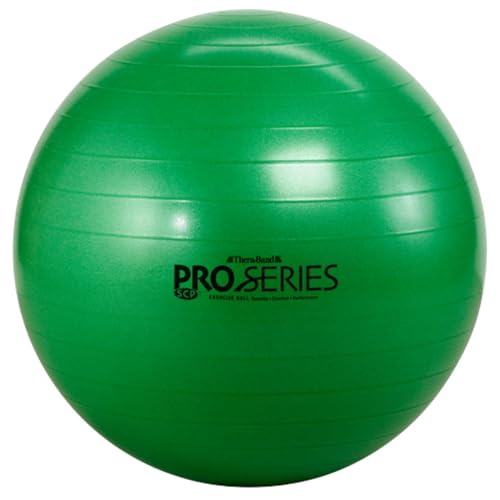
THERABAND is the one listing that tells you who the ball fits. It specifies 26 in, which is 65 cm, and states the design targets users 5'7" to 6'1" tall. No other pick here publishes a height range, and that single line saves more returns than any durability adjective.
The rest of the case is clinical rather than numerical. THERABAND calls the Pro Series a durable slow-deflate ball made from burst-resistant material, and says it wipes clean with a damp cloth. That combination is why you see this range in physio settings: a ball that goes flat gradually and can be sanitised between users. At 2 lb it's the lightest full-size shell in the set, and the published packed size is 9.69 x 5.2 x 8.23 in. Model 23035, in green.
Now the honest part. This is the most expensive pick in the set, and it publishes neither a static load figure nor an anti-burst number nor a warranty term. Black Mountain and ProBody both publish load numbers and warranties for less. No pump is listed either, so budget for one.
Pros:
- Only pick publishing a height range, 5'7" to 6'1"
- Slow-deflate construction stated by the manufacturer
- Wipe-clean surface suited to shared use
- Lightest full-size shell here at 2 lb
Cons:
- Most expensive pick with no published load rating
- No warranty term stated
- No pump listed as included
- Green is the only colour shown
5. ProBody Pilates Ball Small — Best budget pick
A 9-inch therapy ball for squeezes and Pilates work, and the cheapest pick here by a wide margin.
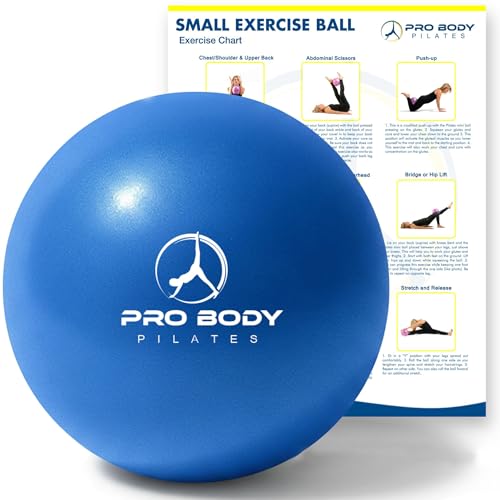
Best for: adductor squeezes, Pilates work and physio homework Skip it if: you need something to sit on
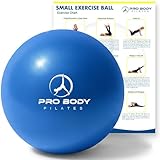
Different tool, same shelf. This is a 9-inch ball weighing 3.2 oz, and ProBody is direct about the job: the size physio clinics stock, handed to patients for home protocols and squeezes between the knees. The listing argues the 9-inch diameter stays put between adult knees and gives firm-but-yielding pressure you can hold past 30 seconds without grip fatigue.
That specificity is the appeal. Small balls in the 6 to 7 inch range slip; larger ones force the knees too wide. A 9-inch ball is the compromise, and it's cheap enough to keep one in a desk drawer and one in a gym bag.
It also travels in a way no full-size ball does. Packed at 0.79 x 5.91 x 3.15 in and 3.2 oz, it fits a laptop sleeve. ProBody backs it with a one-year manufacturer warranty, the same term as its 65 cm ball, and describes itself as a small US business founded in 2014 that inspects each ball before shipping. Model 4808474, blue.
The limit is obvious. You cannot sit on it, cannot do a bridge on it, cannot use it for active sitting. It also publishes no load rating at all, which for a squeeze ball matters less but still leaves the durability question open.
Pros:
- Cheapest pick in this comparison
- 9-inch size matched to adult knee width
- Packs to 0.79 x 5.91 x 3.15 in at 3.2 oz
- One-year manufacturer warranty
Cons:
- No load rating published at all
- Cannot replace a full-size stability ball
- No pump mentioned in the listing
- Blue is the only colour listed
Which diameter matches your height?
This is the decision most buyers get wrong, and it's the one that can't be undone.
The rule of thumb: sitting on a correctly inflated ball, your hips should be level with or slightly above your knees, with feet flat. Too small and your knees ride up. Too large and your feet dangle.
Here's how the picks map:
- Under 5'7": none of these full-size balls is ideal. THERABAND states its range starts at 5'7", and the 58 to 65 cm picks sit near the same band. Look at a 55 cm ball instead.
- 5'7" to 6'1": THERABAND's 26 in, ProBody's 58 to 65 cm, or Trideer's 58 to 65 cm. Three of five picks land here, which tells you where the market is.
- Above 6'1": the Black Mountain 85 cm ball. It's the only pick in this set built for that height, and it's the main reason it wins.
- Any height, for squeezes: the 9-inch ProBody. Height is irrelevant when the ball sits between your knees.
Two of these listings state a size as a range rather than a fixed number, which is a hint about inflation. You control diameter with air. Underinflate a 65 cm ball and it behaves like a 58 cm one, softer and more stable. Overinflate and it gets firm and twitchy. Start softer than you think and add air over the first week.
Why anti-burst matters more than the load number
A 2000 lb static rating is a comforting figure and a slightly misleading one. Nobody puts 2000 lbs on a stability ball. What actually happens is a stray staple, a dropped dumbbell edge or a rough concrete floor, and then what matters is how the ball fails.
That's what the anti-burst language is for. Black Mountain states a 1000 lb anti-burst rating. ProBody describes slow deflation instead of a pop. Trideer describes slow air release. THERABAND calls its ball slow-deflate. Four of the five listings address failure mode, which is the single most useful pattern in this comparison for anyone shopping for the best commercial grade exercise ball.
Two things follow from that:
- Prefer stated failure behaviour over a big static number. A ball that sinks over 30 seconds lets you step off. One that bursts drops you on the floor mid-rep.
- Match the load claim to your actual use, not to your ego. Trideer's 330 lb figure covers body weight plus dumbbells for most people. It's the lowest number here and still comfortably above a typical loaded set.
Floor surface is the other half. Trideer is the only pick that describes an anti-slip texture, and on tile or laminate that's worth more than a load rating you'll never approach.
What owning one actually involves
Three things nobody mentions before you buy.
Inflation takes two sessions. Every one of these balls stretches after first inflation. Pump to roughly 80% of target, leave it a day, then top up. Black Mountain, ProBody's 65 cm and Trideer all include a pump. THERABAND and the 9-inch ProBody don't list one, so plan accordingly.
Storage is the reason balls get abandoned. A 65 cm ball is a beach ball you can't put away. The 85 cm Black Mountain is worse. The 9-inch ProBody, at 3.2 oz and under 6 inches packed, is the only pick here you can genuinely stash.
Cleaning matters if more than one person uses it. THERABAND explicitly says its surface wipes clean with a damp cloth, which is the only cleaning instruction published across these five listings. If your ball is shared, that line has real value.
Two of the picks name specific routines worth borrowing. ProBody suggests ten-minute daily core sessions and physio homework between visits. Trideer names active sitting for posture and back discomfort from long office days. A ball you sit on for part of the workday gets used. One you save for workouts usually doesn't.
The verdict
Split by price position, because that's what decides this one.
Entry tier. Trideer's 58 to 65 cm ball and the 9-inch ProBody sit at the bottom of this set, and neither feels compromised for it. Trideer gives you a one-year warranty, anti-slip texture, a pump and two air stoppers, with a 330 lb stated limit that covers real training loads. The 9-inch ProBody isn't a rival at all, it's a companion, and it's cheap enough to own alongside a full-size ball.
Middle tier. ProBody's 65 cm ball is the family answer. An 880 lb tested claim, documented slow deflation, a one-year warranty and a dual-action pump, on a diameter that fits the widest band of adult heights.
Premium tier. This is where the two top picks live, and they take opposite routes. Black Mountain buys you size and numbers: 85 cm, 2000 lbs static, 1000 lbs anti-burst, though only a 90-day warranty. THERABAND buys you clinical detail instead, a stated 5'7" to 6'1" fit range and a wipe-clean slow-deflate shell, with no load figure at all.
The default is Black Mountain, because in a category built on vague adjectives it publishes the most specific numbers. The exception is height. If you're under 6 feet, the 85 cm ball is simply too big, and Trideer or ProBody's 65 cm is the better buy.
FAQ
Is a commercial grade exercise ball worth the extra money?
A commercial grade exercise ball is worth it when the listing backs the phrase with a number. Black Mountain publishes 2000 lbs static and 1000 lbs anti-burst; ProBody publishes an 880 lb tested figure. Those are checkable claims. THERABAND charges the most here and publishes no load figure, so you're paying for brand and a stated height range instead.
What size commercial grade exercise ball should I buy?
The size commercial grade exercise ball you need depends on your height. THERABAND's 26 in model states a 5'7" to 6'1" range, and the 58 to 65 cm picks target a similar band. Above 6'1", the 85 cm Black Mountain is the only pick here that fits. Sitting on it, your hips should sit level with or just above your knees.
Black Mountain 85 cm or Trideer 65 cm: which should I choose?
Choose Black Mountain 85 cm if you're over 6 feet or want the highest published load claims, 2000 lbs static and 1000 lbs anti-burst. Choose Trideer if you're average height and want one ball for yoga, floor work and desk sitting. Trideer costs less, carries a one-year warranty against Black Mountain's 90 days, and adds anti-slip texture.
Do these exercise balls come with a pump?
Three of these exercise balls come with a pump. Black Mountain includes a ball pump and starter brochure, ProBody's 65 cm ball includes a dual-action pump, and Trideer includes a size-matched pump plus two air stoppers. THERABAND and the 9-inch ProBody don't list one. Check before you order, because inflating a 65 cm ball without a proper pump is genuinely difficult.
What's the most common mistake when buying an exercise ball?
The most common mistake when buying an exercise ball is inflating it fully on day one. Every ball here stretches after first inflation, so pump to roughly 80%, wait a day, then top up. The second mistake is buying by price rather than diameter. A ball 10 cm too small never gets comfortable, and no warranty covers a sizing error.
Start with your height, then check the load figure, then look at price. That order gets you the right ball more reliably than any brand name does. If you're over 6 feet, order the 85 cm Black Mountain and take the 90-day warranty as the cost of the biggest published load numbers in this group. Everyone else should look hard at Trideer's 58 to 65 cm ball first, because a one-year warranty, an included pump and anti-slip texture cover the failures that actually happen. Then add the 9-inch ProBody. It costs little, packs into a drawer, and does the squeeze work no full-size ball can.